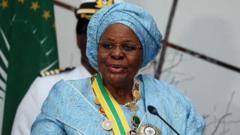
Namibian President Netumbo Nandi-Ndaitwah has made headlines with her recent proposal to eliminate all university fees by 2026. This announcement, made during her inaugural state of the nation address, marks a significant step in Namibian education policy as she aims to make higher education accessible to all.
During her speech, Nandi-Ndaitwah assured lawmakers that students would no longer be responsible for registration or tuition fees at public universities and technical colleges. However, the president emphasized that there would be "no significant" increase in funding allocated to this initiative, raising important questions concerning its practical implementation.
The president intends for the initiative to be gradually phased in, with students and their families expected to contribute mainly towards accommodation and related costs. Her acknowledgment of student demands for accessible education, particularly referencing the “Fees have Fallen” movement, speaks to the ongoing push for educational reform that echoes across borders, particularly from South Africa.
While many student organizations have lauded the move, other groups, such as the Affirmative Repositioning Student Command (ARSC), have expressed skepticism. They criticized the announcement as lacking clarity and detail, questioning which students would actually benefit and what the long-term financial strategy would be. The ARSC characterized the proposal as an attention-seeking ploy, asserting the need for a more concrete plan.
Echoing concerns, economist Tannen Groenewald highlighted that without significant funding, this initiative could potentially limit student enrollment or only assist students from low-income households. This scenario is reminiscent of South Africa's earlier attempts at similar reforms, which ultimately left many students underserved.
As Namibia takes significant strides toward educational equity, the path forward remains uncertain, with hopes pinned on addressing these financial and logistical challenges to truly fulfill the promise of accessible education for all.
During her speech, Nandi-Ndaitwah assured lawmakers that students would no longer be responsible for registration or tuition fees at public universities and technical colleges. However, the president emphasized that there would be "no significant" increase in funding allocated to this initiative, raising important questions concerning its practical implementation.
The president intends for the initiative to be gradually phased in, with students and their families expected to contribute mainly towards accommodation and related costs. Her acknowledgment of student demands for accessible education, particularly referencing the “Fees have Fallen” movement, speaks to the ongoing push for educational reform that echoes across borders, particularly from South Africa.
While many student organizations have lauded the move, other groups, such as the Affirmative Repositioning Student Command (ARSC), have expressed skepticism. They criticized the announcement as lacking clarity and detail, questioning which students would actually benefit and what the long-term financial strategy would be. The ARSC characterized the proposal as an attention-seeking ploy, asserting the need for a more concrete plan.
Echoing concerns, economist Tannen Groenewald highlighted that without significant funding, this initiative could potentially limit student enrollment or only assist students from low-income households. This scenario is reminiscent of South Africa's earlier attempts at similar reforms, which ultimately left many students underserved.
As Namibia takes significant strides toward educational equity, the path forward remains uncertain, with hopes pinned on addressing these financial and logistical challenges to truly fulfill the promise of accessible education for all.