In brief
The recent reinstallation of the statue of Spanish conquistador Francisco Pizarro in Lima has ignited protests from indigenous leaders who view him as a figure of colonial violence, while supporters argue for the recognition of historical context.
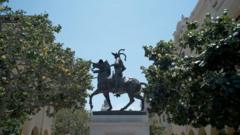
Article text:In a highly contentious move, the statue of Francisco Pizarro, the Spanish conquistador credited with the founding of Lima, was reinstated in the heart of Peru's capital after being removed for over two decades. The unveiling coincided with the 490th anniversary of Lima's founding and has reignited deep-seated tensions regarding whose history is celebrated.Pizarro, who conquered the Inca Empire in the 16th century, is regarded as a pivotal figure in Peruvian history by some, while others, particularly indigenous leaders, view him as a colonizer responsible for cultural destruction and violence. The bronze statue, originally sculpted by American artist Charles Rumsey to commemorate Lima's centenary in 1935, features Pizarro on horseback with a drawn sword—a representation that has drawn ire from various community groups.Previously located near train tracks, the statue was deemed damaged and removed in 2003 amid controversies surrounding historical representation. Luis Bogdanovich, involved in the restoration of the historic center, noted the wear inflicted by trains led to its relocation.During the recent ceremony officiated by Lima's mayor, Rafael López Aliaga, and Isabel Díaz Ayuso, the president of Madrid, discussions centered on the dual nature of the city's history. Díaz Ayuso emphasized the idea of a "historic encounter" that reshaped the world, a sentiment met with fierce opposition just steps away from the Plaza de Armas. A protest saw activists vocally decry the statue's return, claiming it represents an affront to Peru's indigenous peoples. "This is an offence, an offence to all the indigenous peoples of Peru, Latin America and the world," stated one demonstrator, highlighting the stark divisions in perceptions of Pizarro's legacy. This reinstallation invites further discourse on how history is interpreted and celebrated, especially in a nation where colonial narratives continue to provoke strong and passionate responses.