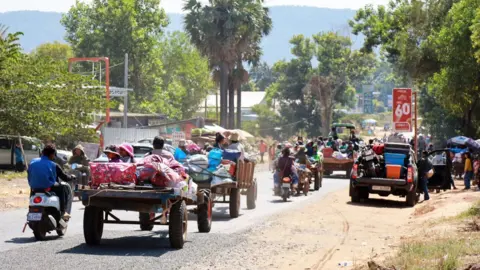
On Monday, residents on both sides of the Thailand-Cambodia border evacuated en masse as new violence erupted, claiming at least five lives. The confrontation is described as the most serious since a ceasefire was established in July.
Each nation blames the other for instigating the violence, with Thailand's Prime Minister Anutin Charnvirakul asserting his country’s stance against aggression, while Cambodia's former leader Hun Sen accused Thailand of provocations. The escalating tensions have contributed to over 40 fatalities, alongside travel restrictions and trade bans.
On the ground, the Thai military reported they responded to Cambodians firing across the border in Ubon Ratchathani Province, which included airstrikes. Conversely, Cambodia’s military claimed the Thai forces were the initial aggressors. The rising conflict has seen the death of one Thai soldier and several Cambodian civilians, officials said.
For many children living in these regions, the ongoing conflict represents a tumultuous barrier to their education. Thai educator Siksaka Pongsuwan highlighted the adverse effects on youth development, stating that they are 'losing opportunities and precious time' as schools shut down amidst the turmoil.
Nearly 650 schools across five provinces in Thailand have been closed for safety reasons. Similarly, parents in Cambodia rushed to retrieve their children from schools amid chaotic scenes. This turmoil disrupts not only immediate safety but also the long-term education and wellbeing of these children.
As the conflict unfolds, communities remain conflicted about whether to stay or seek refuge elsewhere. Gunfire is still heard within some villages, leaving residents uncertain about their future.
The territorial dispute, rooted in a century-long history since colonial boundaries were drawn, continues to resurface with periodic violence influencing the lives of those living in underrepresented and vulnerable communities along the border.