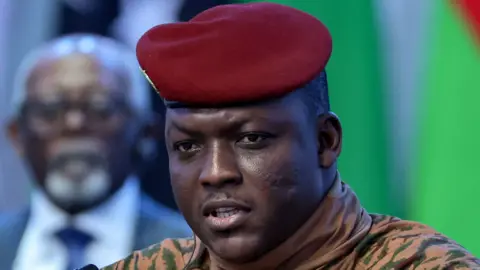
Democracy 'kills' and the people of Burkina Faso must 'forget' it, the country's military ruler has said in an interview aired on state television.
Capt Ibrahim Traoré, who seized power in a coup three years ago, suggested most Africans do not want the system of democracy and that Burkina Faso had its own, alternative approach, without giving details.
Traoré initially pledged to restore democratic rule to the West African country by July 2024, but two months before this deadline, the junta announced it would extend its rule for another five years.
In January, the authorities announced a ban on all political parties as part of a plan to 'rebuild the state'.
In Thursday night's interview, Traoré stated: 'People need to forget about the issue of democracy. Democracy is not for us.'
'Look at Libya, this is an example close to us,' said the 38-year-old, who positions himself as a revolutionary leader standing up to Western imperialism. Libya was ruled autocratically for four decades by Colonel Muammar Gaddafi, who oversaw a brutal regime providing Libyans with subsidised housing, education, and healthcare, but was killed during a rebellion aided by Western military intervention.
He further emphasized that 'wherever they [Western powers] try to establish democracy in the world, it's always accompanied by bloodshed.'
While many African countries still hold regular elections, often criticized as rigged, Traoré condemned traditional politics in the region as corrupt and dishonest.
Instead of proposing a new political system, he underscored the need for Burkina Faso to establish a governance framework based on sovereignty, patriotism, and grassroots involvement.
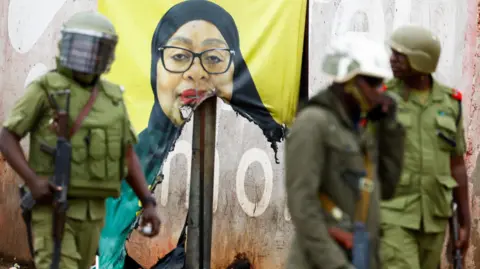
His regime has faced significant backlash, being accused of suppressing dissent and being linked to thousands of civilian deaths since he took power.
As Burkina Faso, along with neighboring Mali and Niger, moves away from Western alliances in the face of rising Islamist violence, Traoré's rhetoric continues to appeal to a segment of the populace disillusioned with foreign influence.