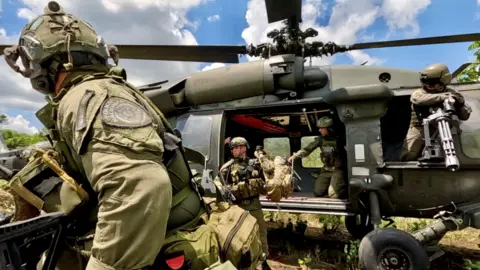
The Black Hawk helicopter was ready for take off – its rotor blades slicing through the air in the deadening heat of the Colombian Amazon. We ducked low and crammed in alongside the Jungle Commandos – a police special operations unit armed by the Americans and originally trained by Britain's SAS, when it was founded in 1989.
The commandos were heavily armed. The mission was familiar. The weather was clear. But there was tension on board, kicking in with the adrenaline. When you go after any part of the drug trade in Colombia, you have to be ready for trouble.
The commandos often face resistance from criminal groups, and current and former guerrillas who have replaced the cartels of the 1970s and 80s.
We took off, flying over the district of Putumayo - close to the border with Ecuador - part of Colombia's cocaine heartland. The country provides about 70% of the world's supply.
Just ahead two other Black Hawks were leading the way.
Down below us there was dense forest and patches of bright green – the tell-tale sign of coca plant cultivation. The crop now covers an area nearly twice the size of Greater London, and four times the size of New York, according to the latest figures from the United Nations Office on Drugs and Crime (UNODC), published in 2024.
After 20 minutes, we land at a clearing in the jungle and see the first stage of a global drug trade. The commandos lead us to a crude cocaine lab, partly hidden by banana trees. It's little more than a shack but it has the key ingredients – drums of chemicals and a mound of fresh coca leaves, ready to be turned into a paste.
Two women and a man emerge from the trees, probably workers at the lab – willing or unwilling. One of the women is in torn clothing and all wear wellington boots. The commandos question them briefly but make no arrests. Colombia's anti-narcotics strategy targets those at the top of the cocaine trade, not the dirt-poor farmers at the bottom.
Minutes later we are rushed away as the commandos prepare to set the lab alight – destroying the crop and the chemicals.
"There are 50 or 60 more labs in this area," says one officer, who does not want to be named. Dense black smoke rises from the forest as we take off. An energy drink is handed around among the commandos, who could soon be doing this all over again. Weather permitting, it's rinse and repeat. They carry out these operations several times a day.
His enemy is evolving. Colombia's drug gangs use drones and bitcoin and bring chemists into the jungle to create ingredients on site. Major Cedano Díaz, 37, admits the cocaine war may not be over in his lifetime. I dream of the day [when that happens], he says. I imagine our descendants see it and will remember those we lost to achieve that goal.
For local farmers like Javier, life remains a daily struggle. In the Andes mountains, he grows coca to feed his family, asserting that without it, they would starve. He acknowledges the damaging impact of cocaine but sees no alternatives given the socio-economic conditions.
Both Major Cedano and Javier represent the conflicting sides of Colombia’s drug war, each hoping for a different future for their children.
The commandos were heavily armed. The mission was familiar. The weather was clear. But there was tension on board, kicking in with the adrenaline. When you go after any part of the drug trade in Colombia, you have to be ready for trouble.
The commandos often face resistance from criminal groups, and current and former guerrillas who have replaced the cartels of the 1970s and 80s.
We took off, flying over the district of Putumayo - close to the border with Ecuador - part of Colombia's cocaine heartland. The country provides about 70% of the world's supply.
Just ahead two other Black Hawks were leading the way.
Down below us there was dense forest and patches of bright green – the tell-tale sign of coca plant cultivation. The crop now covers an area nearly twice the size of Greater London, and four times the size of New York, according to the latest figures from the United Nations Office on Drugs and Crime (UNODC), published in 2024.
After 20 minutes, we land at a clearing in the jungle and see the first stage of a global drug trade. The commandos lead us to a crude cocaine lab, partly hidden by banana trees. It's little more than a shack but it has the key ingredients – drums of chemicals and a mound of fresh coca leaves, ready to be turned into a paste.
Two women and a man emerge from the trees, probably workers at the lab – willing or unwilling. One of the women is in torn clothing and all wear wellington boots. The commandos question them briefly but make no arrests. Colombia's anti-narcotics strategy targets those at the top of the cocaine trade, not the dirt-poor farmers at the bottom.
Minutes later we are rushed away as the commandos prepare to set the lab alight – destroying the crop and the chemicals.
"There are 50 or 60 more labs in this area," says one officer, who does not want to be named. Dense black smoke rises from the forest as we take off. An energy drink is handed around among the commandos, who could soon be doing this all over again. Weather permitting, it's rinse and repeat. They carry out these operations several times a day.
His enemy is evolving. Colombia's drug gangs use drones and bitcoin and bring chemists into the jungle to create ingredients on site. Major Cedano Díaz, 37, admits the cocaine war may not be over in his lifetime. I dream of the day [when that happens], he says. I imagine our descendants see it and will remember those we lost to achieve that goal.
For local farmers like Javier, life remains a daily struggle. In the Andes mountains, he grows coca to feed his family, asserting that without it, they would starve. He acknowledges the damaging impact of cocaine but sees no alternatives given the socio-economic conditions.
Both Major Cedano and Javier represent the conflicting sides of Colombia’s drug war, each hoping for a different future for their children.