In brief
Amidst escalating tensions, the US military executed a complex nighttime operation to rescue a downed airman in Iran after his F-15 fighter jet was shot down. The mission, involving extensive coordination with the CIA and significant military resources, underscores the challenges faced in hostile territories. The cool strategic maneuvers in dark conditions ultimately led to the successful extraction of the airman.
The US military has rescued a missing crew member in a dramatic night-time mission after his fighter jet was shot down in a remote part of Iran.
The exact circumstances remain unclear, but the operation to extract him from the ground in hostile territory was hugely complex.
Hundreds of special forces, as well as dozens of US fighter jets and helicopters, were involved in the plan, along with the CIA.
On Sunday, US President Donald Trump said on social media: We have rescued the seriously wounded, and really brave, F-15 Crew Member/Officer, from deep inside the mountains of Iran.
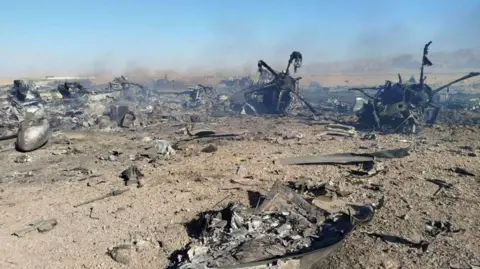
But the airman's ordeal began on Friday with reports that an F-15 jet, which was carrying a weapons systems officer and a pilot, had been shot down over southern Iran.
The incident was the first US fighter jet to be shot down by enemy fire in more than 20 years.
The two US military personnel on board the F-15E Strike Eagle managed to eject from the aircraft, and the pilot was rescued the same day, but the second crew member was missing.
The US then began a race against time to locate him.
Iran made it clear they wished to capture him alive and offered a bounty of £50,000 ($66,100).
Videos shared on social media, which have not been verified by the BBC, appeared to show armed civilians searching for him.
Once the officer was on the ground, he had only a handgun to defend himself, US officials told the BBC's US partner CBS News.
The airman would have received training for a situation like this, and it would have involved turning his beacon signal on, getting to high ground, concealing himself, and establishing communications.
According to reports in US media, the airman hid himself in a mountain crevice and restricted the use of his beacon - concerned the signal could be picked up by Iran.
He then waited for his rescuers to arrive.
The CIA played a crucial role in the rescue operation, tracking the airman's exact location and passing the information to the Pentagon.
As US special forces approached the location, bombs and weapon fire were used to keep Iranian troops away from his position. President Trump stated that dozens of aircraft, armed with the most lethal weapons, were sent to retrieve him.
The mission concluded successfully before midnight US time, and the airman was flown to Kuwait for medical treatment. Trump reported that despite being seriously wounded, he would recover.