In brief
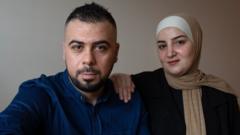
In London, Douna Haj Ahmed discovers the chilling reality of her husband Abdullah Al Nofal's detention in Syria's Al-Khatib prison, a revelation that redefines their shared life narrative while highlighting the struggle for justice and remembrance among Syrian refugees.
In early December, the past came rushing back for Douna Haj Ahmed, a Syrian refugee living in London, as she watched footage of prisoners escaping Syria's oppressive regime on the news. The moment became surreal when her husband, Abdullah Al Nofal, turned to her and said, "This is where I was arrested." For the first time, Abdullah was ready to share the full extent of his trauma from his detention in the infamous Al-Khatib prison, known widely as "Hell on Earth."The couple sat together as Abdullah, who generally keeps his emotions guarded, opened a floodgate of memories. "I saw him weak. I saw him crying," Douna shared with heartache, recounting their experience. She hinted at a shared grief, as her brothers also fell victim to the brutalities of the ongoing Syrian civil war. It was a pivotal moment in their relationship, one where Abdullah finally felt he could express his pain, bringing them closer together in their shared mission to convey the stories of Syrian suffering. Abdullah, aged 36, was a storekeeper for the International Committee of the Red Cross in Damascus when he was apprehended in July 2013. Although he had initially participated in peaceful protests in Deraa, he distanced himself when violence marred demonstrations. On that fateful day, while at a checkpoint, he caught the attention of authorities, resulting in his capture and subsequent transport to an unknown military location. He endured solitary confinement and severe beatings during his first few days, which he described as an oppressive darkness, devoid of both light and sound. Eventually, he arrived at Al-Khatib, a complex notorious for its inhumane conditions. According to the Syrian Observatory for Human Rights, it housed thousands of inmates, with an estimated 60,000 tortured and killed under the Assad regime's watch. The German courts have recently condemned a former Syrian officer from Al-Khatib for crimes against humanity, but for many survivors like Abdullah, speaking out has been a lifelong burden.Inside the walls of Al-Khatib, Abdullah witnessed unspeakable horrors—men tortured and left in conditions so desperate that he described looking around at “people standing almost naked, full of blood." The psychological torment weighed heavily on him, magnified by the grim reality that every moment held the potential for death or more torture. After enduring relentless torment including physical beatings and psychological intimidation, Abdullah, though "lucky," was released after a month. He later managed to escape Syria and secure scholarships in Geneva and the United States, ultimately finding solace with Douna in London. The transformation Abdullah underwent, from silence to finding his voice, allowed him to confront years of suppressed trauma. “We finally finished with the regime; we can say we are really free right now,” he asserted, urging society to recognize the ongoing plight of those affected by the Syrian civil war. For Douna, hearing Abdullah recount his experiences marked a painful yet vital awakening. “Every time I feel that this regime [has reached] the maximum of the horrors... it surprises me that, no, this is not the maximum,” she reflected, emphasizing the unending struggle for acknowledgment among Syrian victims.Despite their traumatic past, Douna and Abdullah recognize their privilege in sharing their story, standing as representatives of countless others who have been silenced. They aim to shed light on the horrific realities that many have faced in the shadows, ensuring that the memories of those lost to tyranny are not forgotten.