In brief
Santorini and its neighboring islands have been rocked by thousands of earthquakes over the past weeks, heightening local tensions and prompting emergency measures as residents brace for uncertainty.
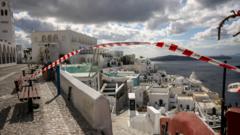
In the past fortnight, the popular tourist destination of Santorini has been gripped by intense seismic activity, culminating in a significant earthquake with a magnitude of 5.3, marking the most powerful tremor in the ongoing series of quakes. This particular earthquake was shallow, occurring at a depth of 17 kilometers (10.6 miles), and its impact was felt as far away as Athens on Monday evening. Neighboring Amorgos Island remains on high alert as tremors continue to affect the region, with the most recent moderate quake recorded at a magnitude of 5.0 occurring the previous evening.Since January, Santorini has experienced over 12,800 earthquakes according to the University of Athens' Seismological Laboratory, leading some residents to take protective measures by patrolling risky areas to dissuade tourists from venture too close to precarious cliffs. The intensity and frequency of these tremors have resulted in numerous landslides across the island, with authorities remaining cautious as they do not rule out the potential for a larger seismic event.Despite the increase in seismic activity, inspections have shown no significant damage to buildings in Santorini or Amorgos, with no reported injuries. Since the earthquakes began, over 11,000 residents have left the islands as a precautionary measure. Schools will be closed on both Santorini and Amorgos for the following days due to safety concerns.In response to the situation, emergency response teams have dispatched special equipment to aid in the event of further disruptions, while technical crews prepare to check the local power grid for potential impacts. Kostas Papazachos, a seismology expert from Aristotle University of Thessaloniki, urged patience as authorities monitor the evolving situation, stating, "Let's hope that we will slowly move towards a gradual de-escalation."Meanwhile, the cruise ship Viking Star, carrying 893 passengers and 470 crew members, diverted its route to dock at Crete to avoid congestion at Santorini's port amidst the ongoing seismic threats. The ship’s change of plans reflects concerns over overcrowding and safety in the popular cruise destination.Greece occupies a significant position along the Hellenic Volcanic Arc, a region historically known for volcanic activity; however, the recent earthquake clusters have puzzled scientists, particularly as they remain unassociated with any major volcanic activity. Greek officials maintain that the quakes are rooted in tectonic plate movements, a complex process presenting difficulties in precisely forecasting earthquakes' timing and severity.As the island grapples with this unprecedented seismic phenomenon, the resilience of its residents and the vigilant approach of local authorities will be crucial in navigating this challenging period of uncertainty.