
In brief
Various firms, predominantly in Asia, are pioneering humanoid robots while navigating obstacles in AI development and manufacturing logistics.
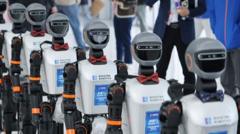
In Hanover, Germany, at the prominent Hannover Messe, I encountered the G1, a humanoid robot designed by Unitree, a Chinese company. Standing at 4'3" (130cm), the G1 is not only smaller but also more affordable than many competitors, equipped to delight attendees with its fluid motions in dance and martial arts, making it a standout attraction at the event.To add to its allure, the G1, controlled remotely by Unitree’s sales manager Pedro Zheng, actively engages with onlookers. People reach out to shake its hand and respond with laughter and excitement as the robot waves or bends, demonstrating an uncanny ability to mimic human-like interactions. This reaction is contrasted with many other machines at the conference, highlighting the G1’s unique charm.Unitree belongs to a larger group of companies across the globe striving to bring humanoid robots to life. The market potential is vast; businesses envision these robots providing a workforce like none other, one unburdened by paychecks or time off. There is also potential for domestic assistance, conjuring images of robots performing various household tasks. However, significant technological hurdles remain. While robots have thrived in controlled factory settings, introducing humanoids into unpredictable environments like homes or restaurants poses safety challenges. The need for advanced artificial intelligence is critical for humanoid robots, as typical AI struggles with logic and complex task execution. A Unitree representative shared, “The AI simply has not yet reached a breakthrough moment,” indicating that their G1 is primarily targeted at research facilities and tech companies that can leverage its open-source software.In today's landscape, many developers focus on humanoid robots for industrial use, with Tesla’s Optimus being a prime example of progress in this field. Elon Musk envisions thousands ready for deployment in Tesla factories, and other major automotive players, like BMW and Hyundai, are also investigating humanoid applications.Market analyst Thomas Andersson, who monitors 49 humanoid robotics enterprises, suggests that Chinese manufacturers are likely to prevail in this sector due to logistical advantages, competitive pricing, and strong governmental support. Unitree's G1, priced at approximately $16,000 (£12,500), illustrates this competitive edge.U.S. and European companies face challenges in competing due to reliance on Asian supply chains, as noted by UK-based entrepreneur Bren Pierce of Kinisi. He creates the KR1, a robot meant for factory work that ditches the full humanoid structure for efficiency. By utilizing mass-produced components, Pierce cuts costs significantly while ensuring accessibility for operators.Despite the advancements, the prospect of humanoid robots populating homes remains a distant reality, according to Pierce, who estimates that reaching this goal could take another decade or more. As the humanoid robotics race continues, companies and researchers navigate a landscape defined by both competition and collaboration, with long-term visions for technology promising potential transformation in everyday life.

