
In brief
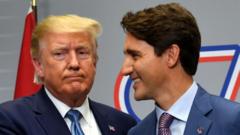
Prime Minister Justin Trudeau has vowed to counter Donald Trump's newly imposed tariffs, categorizing them as harmful and unnecessary, while also alerting Canadians to potential job losses due to the ongoing trade conflict.
Prime Minister Justin Trudeau has struck back at U.S. President Donald Trump’s tariffs on Canadian products, which he termed a "very dumb thing to do." This strong condemnation comes in light of Trump's recent decisions to impose a 25% tariff on goods coming from Canada and Mexico, as well as further increases on imports from China. In retaliation, Trudeau announced reciprocal tariffs on U.S. exports, warning that a trade war would inevitably harm both nations.Trump has made it clear via social media that he is prepared to escalate the situation further, stating that if Canada retaliates with its tariffs, the U.S. would respond with corresponding increases. Trudeau, however, framed the tariffs as an attempt to destabilize Canada’s economy, a notion he flatly rejected, asserting, "We will never be the 51st state." His primary objective remains the swift removal of these tariffs.The trade conflict raised alarm across various sectors, as prices for U.S. and Canadian consumers are likely to be affected, particularly in the import of essential goods such as fruits, vegetables, oil, and gas. Professor John Rogers from American International University warned that the ramifications of such actions could lead to severe repercussions for trade relationships, noting that in a trade war "everybody is a loser."Trudeau and Mexican President Claudia Sheinbaum both dismissed U.S. claims that Canadian imports contribute to the opioid crisis, with Trudeau emphasizing that less than 1% of fentanyl at U.S. borders originates from Canada. In stark contrast, Trump has portrayed his tariffs as a measure to protect American jobs and combat illegal activities linked to drug trafficking.As concerns mount regarding the potential job losses in Canada, Trudeau's government outlined significant retaliatory measures that could affect about C$155 billion (USD 107 billion) of U.S. goods. Some actions are set to be implemented immediately, while others will arrive within weeks. The Canadian economy is heavily intertwined with that of its southern neighbor, putting approximately up to a million jobs at risk, according to Canada's Immigration Minister Marc Miller.With the tensions escalating, some Canadian provinces are considering their responses, including Ontario's Premier Doug Ford, who suggested potential restrictions on energy supplies and a halt to contracts with U.S. companies. Meanwhile, China's inclusion in the trade dispute, now facing its own tariffs, has vowed to retaliate against U.S. agricultural products, further complicating international trade dynamics.As the situation unfolds, the potential costs of these tariffs and retaliatory measures pose significant threats to economic stability for both nations, leading experts to caution against the broader implications of ongoing trade disputes.


