In brief
A study published in 'Science' details how the Ngogo chimpanzees, once a closely-knit community in Uganda's Kibale National Park, have devolved into violent factions, leading to numerous fatalities, including 17 infants. The researchers suggest that social changes and previous conflicts may have triggered this alarming situation, offering insights into the potential origins of group violence in humans.
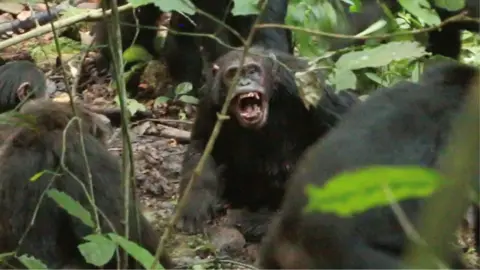
The world's largest known group of wild chimpanzees has split and been locked in a vicious civil war for the last eight years, according to researchers.
It is not clear exactly why the once close-knit community of Ngogo chimpanzees at Uganda's Kibale National Park are at loggerheads, but since 2018 the scientists have recorded 24 killings, including 17 infants.
These were chimps that would hold hands, lead author Aaron Sandel said. Now they're trying to kill each other.
The study, published in the journal Science, says the intensity and duration of the violence may inform how early human conflict developed.
Sandel, an anthropologist from the University of Texas in the US, and co-director of the Ngogo Chimpanzee Project, suggests that chimpanzees are very territorial and exhibit hostile interactions with those from other groups. He described the phenomenon as akin to a fear of strangers, reflecting an instinctual response to conflict.
Despite living harmoniously for decades, researchers first observed polarization among the nearly 200 Ngogo chimpanzees in June 2015. Following a dispute, interactions decreased significantly, with 2018 marking the emergence of two distinct groups: Western and Central.
Research indicates that multiple factors contributed to this split, including the death of key chimpanzee members and changes in social structures. The result has been a tragic rise in aggression, with researchers noting that the violence among the groups may have far-reaching implications for understanding social dynamics and conflict in the animal kingdom.
The findings encourage a reconsideration of what drives conflict, suggesting that relational dynamics may play a larger role in societal rifts than previously thought. This research not only elucidates chimpanzee behavior but may also provide key insights into the evolution of human conflict.