
In brief
Recent comments by former President Trump alleging that China operates the Panama Canal have ignited debates about the actual control and influence of Chinese investments in the region. Despite these claims, Panamanian officials maintain that the canal is solely under their governance.
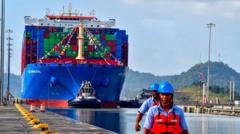
During his inauguration speech, former President Donald Trump reiterated claims that China is operating the Panama Canal, leading to further scrutiny of the geopolitical implications surrounding this critical waterway. Trump stated, "China is operating the Panama Canal and we didn't give it to China. We gave it to Panama and we're taking it back." This assertion raised eyebrows, considering that the canal, which is vital for maritime trade, is managed by the Panama Canal Authority— a Panamanian governmental agency.Historically significant, the canal spans 51 miles (82 km) and serves as the conduit between the Atlantic and Pacific Oceans, vital for international shipping. It processes about 14,000 vessels annually, underscoring its strategic importance. Trump's recent remarks echo previous communications, including a Christmas post on social media where he accused Chinese military personnel of operating the canal, a claim promptly dismissed by both Panamanian President José Raúl Mulino and Chinese authorities. Mulino reiterated during Trump's remarks that "there is absolutely no Chinese interference in the canal," reinforcing the autonomy of Panama’s administration of this crucial waterway. Additionally, U.S. claims of exorbitant fees for U.S. vessels passing through the canal have also been contested by Panamanian officials.The Panama Canal's control transitioned from the United States to Panama following treaties signed in 1977, fully transferring authority to the Panama Canal Authority in 1999. While the canal was historically a U.S. construction endeavor, criticisms of foreign investments from China have led to increased scrutiny. As of October 2023, approximately 21.4% of the cargo volume transiting the canal is from China, making it the second-largest user behind the United States.Despite the absence of any evidence supporting claims that the Chinese government directly operates the canal, significant Chinese investments in nearby ports are evident. Two ports adjacent to the canal, Balboa and Cristóbal, have been under the management of Hutchison Port Holdings since 1997, a subsidiary of a Hong Kong conglomerate. Although privately owned, concerns persist regarding the potential for Beijing to exert influence through these business connections.This growing presence comes amid wider strategic moves by China in the region, following Panama's diplomatic shift in 2017 from Taiwan to China. The country has positioned itself as a significant partner for Latin America through initiatives like the Belt and Road Initiative. Chinese investments continue to flourish, including infrastructure projects and cultural exchanges.As relations between the U.S. and China increasingly test the waters of geopolitical rivalry, Trump’s narrative seems to reflect broader anxieties among U.S. officials about China's expanding influence in Latin America. Nevertheless, Panamanian officials maintain that the control, operation, and oversight of the Panama Canal remains purely in their hands.


