
In brief
An earthquake measuring 6.0 magnitude struck eastern Afghanistan, claiming at least 800 lives and devastating several villages, particularly in Kunar and Nangarhar provinces. Witnesses share harrowing accounts of the night the earth shook, revealing the challenges faced by local populations in the wake of this disaster, including blocked roads and the urgent need for outside assistance.
Just before midnight on Sunday, Matiullah Shahab woke up to find his house in Afghanistan's remote Kunar province shaking.
An earthquake measuring 6.0 magnitude had struck eastern Afghanistan, leaving at least 800 people dead, according to the UN. Even though the epicentre of the quake was 16km (10 miles) away, the whole of Shahab's village of Asadabad trembled. The 23 family members who live with him ran out of their bedrooms as they feared the walls would fall in on them and stayed awake all night in their garden. 'We were all afraid,' he says.
The areas worst hit by the quake were Nangarhar and Kunar provinces, but it was felt as far away as Kabul and in neighbouring Pakistan's capital, Islamabad.
When day broke, Matiullah - who is a freelance journalist and human rights activist - drove from his home to try to reach the remote mountainous area at the epicentre of the quake. He says he had to get out of his car and walk for two hours before he arrived at the worst-hit villages as there were rocks on the road.
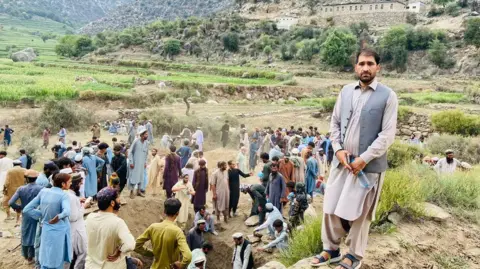
He arrived at the village of Andarlachak to find several young children being treated by medics in the street. A pair of toddlers lay together on a stretcher with bruises on their chests and faces. Other children were wrapped in white sheets. Some 79 people died in that village alone.
'I saw many dead bodies,' Matiullah tells the BBC. 'I felt the aftershocks 17 times.'
Matiullah helped the local people dig graves for those who had died. 'The villages I visited were destroyed,' he says. One man told Shahab that his wife and four children had died. But most were too shocked to speak. 'Peoples' faces were covered in dust and there was a silence,' he said. 'They were like robots - no one could talk about it.'
Due to the blocked roads, Taliban government rescue operations have relied on helicopters to reach the mountain villages. However, the remote terrain means some places remain inaccessible, while there are reports of people dying under the rubble while awaiting rescue.
Another resident in Kunar's Sokai district, Ezzatullah Safi, said part of his house collapsed in the earthquake. 'I woke to the screams of children, women, and animals,' he tells the BBC. 'The earthquake was intense, and the night felt like a small apocalypse. Strong winds followed the tremors, with light rain falling. My children clung to me, crying in fear. Dust filled the air.'
He says government helicopters arrived in the morning and airlifted the injured from the mountains down to the main Kunar highway, where they were transferred by vehicles to clinics. 'There's a heavy atmosphere of grief here,' Ezzatullah notes. '[The] electricity is out, markets remained closed all day. Some areas are still unreachable - remote villages five to six hours away in the mountains.'

