
In brief
Asian stock markets experienced their largest declines in decades as U.S. tariffs announced by President Trump raised fears of a global recession. Key economic players like China, Japan, and South Korea saw substantial drops, with analysts predicting continued turmoil in the coming months.
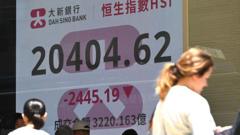
Asian stock markets faced their most drastic declines in decades this week as the ramifications of President Donald Trump's recently announced tariffs began to take their toll. Major indices from Shanghai to Tokyo, Sydney, and Hong Kong reported considerable losses, reflecting widespread concerns over a potential global trade war.The Shanghai Composite index dropped over 8% during Monday trading, while Hong Kong's Hang Seng Index saw a staggering decrease of more than 13%. Japan's Nikkei 225 took a hit, closing down by 7.8%. Analysts labeled the market chaos a "bloodbath," indicating the severity of the downturn.European markets followed suit, with early trading showing declines, particularly in banking and defense sectors. Leading up to this, the announcement of new tariffs ranging from 10% to 46% on a wide array of products struck a blow to Asia's manufacturing hubs reliant on U.S. exports.Countries such as Japan and South Korea are facing tariffs around 26%, while developing nations like Vietnam brace for even higher levies, with Trump referring to Vietnam as one of the "worst offenders." Other nations such as Cambodia, Thailand, and China are confronted with tariffs of 49%, 36%, and an overall 54%, respectively.The significance of these developments is heightened by the fact that Asian economies are acutely sensitive to shocks in the global economy, particularly fears of a recession in the U.S. – the largest economy in the world. Jonathan Wang, an economist at Vanguard, emphasized that while there might be prospects for negotiation, a new, elevated tariff regime appears to be a lasting reality.Amid concerns about weaker Asian exports, investors faced additional pressures as they returned to the market after public holidays, which exacerbated regional downturns. The Shanghai Composite index ultimately closed down by 7.3%, while the Taiwan Weighted Index suffered a record fall of 9.7%. The ASX 200 in Australia recorded a decline of 4.2%, and South Korea's Kospi closed 5.6% lower.As anticipated inflation and recession fears surfaced, major financial institutions like Goldman Sachs revised their U.S. recession probability to 45%, a notable increase from the earlier estimate of 35%. Similarly, JPMorgan raised the likelihood of a global downturn to 60%.Frank Lavin, a former trade official, pointed out that the Asian region will likely absorb a disproportionate impact due to its significant export ties to the U.S. Countries, from Vietnam to Bangladesh, are heavily dependent on U.S. exports, and recent tariff decisions could jeopardize their economies.The broader consequences were evident as global markets lost trillions in value following Trump's tariff rollout, with key trading partners like China and the European Union facing increased rates. Observers now speculate that ongoing market volatility is anticipated, especially in light of U.S. futures indicating further declines in the coming trading sessions.

