In brief
India's trade detachment may prove advantageous during global trade slowdowns, despite ongoing protectionist policies that limit competitiveness. Experts argue for strategic openness to global markets.
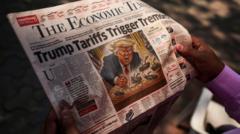
India, the world's fifth-largest and fastest-growing major economy, has faced challenges stemming from a legacy of protectionism that has somewhat hindered its foreign trade competitiveness. Higher tariffs and a modest share of global exports—less than 2%—reflect longstanding inward-focused trade policies. However, amid global economic turbulence and increasing protectionist measures, some economists suggest that India’s instinct for self-reliance may function as a short-term safeguard.In this landscape, where countries are recalibrating trade partnerships in light of shifting US policies—exemplified by Donald Trump’s recent 90-day tariff pause—India’s limited exposure to global goods trade could fortuitously bolster its resilience. “If export-driven economies are hampered by tariff pressures while we continue to grow at 6%, India will appear stronger by comparison,” posits Rajeswari Sengupta, an economist at Mumbai’s Indira Gandhi Institute of Development Research.Nevertheless, Sengupta urges caution. The path forward involves India remaining agile while gradually opening up trade. This, however, is no easy feat given the country’s intricate history with trade barriers. In 2024, India marked $89 billion in exports to the US market alone. Historically, protectionist measures have rooted deeply in India's trade strategy, with industries such as textiles and iron claiming high levels of protection, even during global economic peaks. As noted by economist Arvind Panagariya, this led to a loss of competitiveness for Indian products throughout the 20th century.A dramatic shift occurred in 1991 when India confronted a balance-of-payments crisis, which led to the dismantling of many protective measures. As trade barriers fell and liberalization advanced, the nation experienced a six-fold surge in exports over a decade. Growth was notable, yet the pushback against trade liberalization has resurfaced sporadically, particularly from 2018 onward, reinforcing a protective environment around Indian industries.According to Vivek Dehejia, a Canadian economist, a historical skepticism towards international trade lingers, echoing fears of neo-colonialism. For India's trade policy to thrive, it must reconsider its protective stance which, over the decade, has stifled the potential of initiatives like “Make in India”.The present climate, with the US withdrawing towards protectionism and Europe seeking reliable trade partners, offers India a moment to attract international business. However, economists emphasize the need for significant reforms like reducing tariffs, enhancing export competitiveness, and fostering an inviting stance towards global trade partners.Sectors like garments, textiles, and toys present emerging opportunities, especially for small and medium enterprises. Yet questions remain about their ability to scale and receive government support.If the Trump administration proceeds with its tariff plans post-pause, projections indicate India could see a substantial drop in exports to the US. Experts assert that broadening the trade base through balanced agreements, including with the EU, UK, and Canada, is crucial.On the home front, real change hinges on reforming tariffs and enhancing trade efficiency. Absent these developments, India risks falling behind in seizing global opportunities.