
In brief
Despite anticipated challenges from US tariffs, China's economy showed resilience with a growth rate of 5.2% in the second quarter, outpacing expectations.
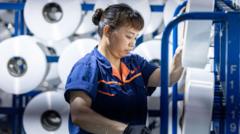
China's economy is proving unexpectedly resilient as it contends with looming tariffs from the United States and ongoing struggles in its property market. According to official statistics released recently, the world's second-largest economy has recorded a growth rate of 5.2% for the second quarter—surpassing the 5.1% forecast by many analysts. However, this growth is lower than the previous quarter’s performance. This resilience can be partially attributed to measures implemented by Beijing aimed at bolstering economic stability, alongside a fragile trade agreement with Washington. Officials from China's National Bureau of Statistics commented that the economy has “withstood pressure and made steady improvement despite challenges.” A key driver of this growth has been a notable 6.4% expansion in manufacturing sectors, fueled by rising demand for advanced technology including 3D printers, electric vehicles, and industrial robots. Furthermore, the services sector encompassing transportation, finance, and technology has also recorded gains. Nevertheless, retail sales have demonstrated signs of deceleration, with a recorded growth of only 4.8% in June, compared to a stronger 6.4% increase in May. Additionally, recent data indicates that new home prices dropped at their steepest rate in eight months, highlighting persistent issues within the real estate market despite various interventions to stabilize property prices.Market analysts had previously anticipated a more significant negative impact from the tariffs imposed by the US. However, economist Gu Qingyang from the National University of Singapore remarked on the economy’s commendable resilience, attributing some of this growth to increased exports, particularly as companies sought to expedite shipments prior to potential new tariffs and strategic adjustments.The outlook for the second half of 2023 appears to be more uncertain, prompting expectations for the government to potentially introduce more robust fiscal stimulus. Some experts, like Dan Wang from the Eurasia Group, predict that China may struggle to meet its growth target of around 5% this year, although they believe it can maintain a minimum growth threshold of 4%, which is politically acceptable.The trading discord between China and the US, initiated by President Trump, has resulted in substantial tariffs, including a 145% levy on Chinese imports and reciprocally high duties on US goods. While recent negotiations in Geneva and London have led to temporary pauses in some tariffs, a long-term trade solution is still being sought, with a deadline set for August 12.

