
In brief
This article explores the emergence of humanoid robots, their evolving technology, and the competitive advantages of companies across the globe, especially in Asia.
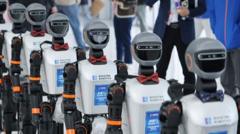
On a vibrant spring morning in Hanover, Germany, the spotlight is on the G1 humanoid robot, designed by the Chinese company Unitree. Debuting at the acclaimed Hannover Messe, this compact robot stands at approximately 4'3" (130cm) and has quickly gained popularity thanks to its impressive agility, showcasing skills that have even gone viral online, from dancing to martial arts. The G1 is controlled remotely by Unitree’s sales manager, Pedro Zheng, who clarifies that each robot requires specific programming to operate autonomously.As bystanders eagerly engage with the robot, some are seen extending hands for a shake or attempting to provoke reactions, underlining the compelling human-like characteristics that immediately alleviate any discomfort despite its robotic form. Such interaction sets the G1 apart from many other displays at the trade show.The potential market for humanoid robots is vast, promising to offer businesses an alternative workforce unencumbered by the typical demands of employment. However, significant hurdles remain, especially when considering the blend of strength and safety required for effective use in everyday settings, like homes or restaurants, where unpredictability and risks can arise. A representative from Unitree highlights that the current state of artificial intelligence lacks the advancements needed for nuanced tasks, with the G1 currently aimed at research and tech sectors utilizing its open-source programming.Entrepreneurs have primarily shifted their focus towards developing humanoid robots tailored for warehouse and factory settings, with Tesla being at the forefront, creating thousands of its humanoid, Optimus. Additionally, BMW and Hyundai are also investing heavily in robotics, seeking innovative solutions through both existing and newly developed humanoid products.Researcher Thomas Andersson tracks over 49 companies engaged in humanoid robotics, suggesting a heavy advantage for Chinese companies due to domestic infrastructure and supportive governmental policies. Unitree’s G1, priced at $16,000 (£12,500), epitomizes this competitive edge. Meanwhile, investments in humanoid technology appear to be favoring Asian markets, capturing nearly 60% of global funding, compared to the U.S.This raises questions about competitiveness for companies in the U.S. and Europe. Bristol's Bren Pierce has founded several robotics firms and recently unveiled the KR1, a robot that, while designed in the UK, is produced in Asia. This approach not only cuts costs but also circumvents challenges associated with sourcing components from abroad. The KR1 is streamlined for functionality in warehouses, intentionally steering clear of complex humanoid design.Bren emphasizes the importance of user-friendly software for his robots, expressing that many high-tech solutions require advanced technical knowledge that could alienate potential users. His goal is to create accessible robots that can be learned and utilized by typical factory personnel with ease, showcasing a vision for more integrated humanoid robotics in the workforce.Despite ambitions for robots to transition into everyday life, industry experts, including Mr. Pierce, indicate that full-fledged humanoid robots in residential settings remain a distant objective, possibly still 10 to 15 years away. As technology progresses, the future of humanoid robots promises to be an exciting arena of innovation.

