In brief
As her six-year term concludes, President Salome Zourabichvili is at the center of a political storm as she refuses to vacate her office, claiming that the newly appointed president lacks democratic legitimacy.
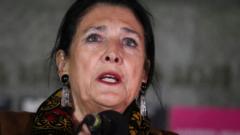
Salome Zourabichvili, Georgia’s pro-Western President, finds herself in a precarious position as her term comes to an end amidst accusations and protests concerning the legitimacy of her successor. The presidential office is poised for a tumultuous transition as Zourabichvili, 72, decries the election of former footballer Mikheil Kavelashvili as a product of a flawed system backed by the ruling Georgian Dream party.With Zourabichvili's term officially ending this Sunday, she states that stepping down would mean conceding to a political regime she labels a tool of Moscow's influence. Tensions have escalated after she called Kavelashvili’s election—a product of an electoral college with only one candidate—a mere "travesty." As she prepares to leave office, the government warns that any defiance from her side could constitute a criminal act.Born into a family of émigrés in France, Zourabichvili has spent decades advocating for Georgia’s alignment with Western Europe. Her journey began in a family deeply affected by Georgia’s tumultuous history, particularly as they fled the Soviet regime in 1921. This mission has embodied her presidency, as Zourabichvili has repeatedly emphasized the need for Georgia to turn away from Russian influence.Since assuming office in 2018, Zourabichvili, initially supported by Georgian Dream, has undergone a significant transformation in political stance, emerging as a vocal critic of the ruling party's increasingly authoritarian measures. In recent months, she has rallied supporters against legislation mirroring Russian laws and has actively participated in pro-European protests, casting the ruling party as a threat to the nation's sovereignty.Despite her attempts to stand against the government's actions, Zourabichvili's past association with Georgian Dream continues to color perceptions of her leadership. Some view her as complicit in the party's earlier decisions, while others see her recent defiance as a necessary uprising against an encroaching authoritarianism.The climax of this political struggle appears imminent, with Prime Minister Irakli Kobakhidze warning of the potential for Zourabichvili's arrest should she refuse to relinquish her position. However, opposition figures speculate that the government will seek to avoid making her a martyr in their cause. The situation remains fluid and precarious, with Zourabichvili prepared to continue her fight for the political future she envisions for Georgia—one of independence from Moscow and a firm embrace of the West. Supporters argue that regardless of the outcome, Zourabichvili will remain a key figure in opposing the ruling party, heralded as a symbol of legitimacy and democratic values amid a backdrop of escalating political strife in Georgia.