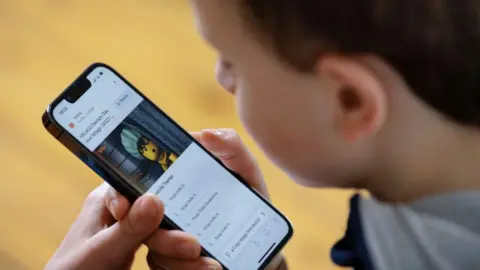
Austria has announced plans to ban social media for children aged under 14, becoming the latest country to consider introducing restrictions for children online. This decision follows lengthy negotiations within the conservative-led three-party coalition government; however, it is still unclear how or when the ban will be enacted.
Vice-Chancellor Andreas Babler of the Social Democrats emphasized the need for action, stating the government could not stand by as social media led to children's addiction and health issues. He argued that children should be treated similarly to how society treats alcohol and tobacco, implying the necessity for clear rules in the digital realm.
Under the proposed legislation, children under 14 would be safeguarded from addictive algorithms and potentially harmful content found online. Babler reiterated that just as other information providers have regulations to protect young people, similar steps should be taken in the digital space.
The Austrian government's initiative aligns with a growing international trend, where numerous countries express concerns over children's exposure to dangerous content. Such discussions have gained momentum, especially after a recent landmark case in the United States, where two major social media firms were found liable for developing algorithms that negatively impacted young people's mental health.
While social media companies claim under-13s are prohibited from joining their platforms (though implementation is questionable), various alternatives such as versions with parental controls exist. Australia previously set a precedent by introducing a ban for minors under 16.
Following a similar pattern, France's lower house recently approved a ban for individuals under 15, garnering support from President Emmanuel Macron, who acknowledged Austria's decision as part of a collective movement. The UK government is also exploring regulations for under-16s, with other European nations, including Denmark, Greece, Spain, and Ireland, considering similar legal frameworks.
Austrian Education Minister Christoph Wiederkehr highlighted the detrimental aspects of social media, advocating for responsible usage education. Furthermore, State Secretary for Digitalisation, Alexander Pröll, asserted that a draft bill detailing the ban would be presented by the end of June. This bill will outline age verification methods to ensure compliance with the new regulations, potentially adopting an EU-wide system or establishing a national approach.
Political analyst Thomas Hofer noted that this embargo is popular with the public, particularly among parents, who feel it addresses an urgent issue. The proposed ban coincides with other contentious reforms in secondary education, including increased lessons on democracy and artificial intelligence, along with a decrease in Latin classes.
Vice-Chancellor Andreas Babler of the Social Democrats emphasized the need for action, stating the government could not stand by as social media led to children's addiction and health issues. He argued that children should be treated similarly to how society treats alcohol and tobacco, implying the necessity for clear rules in the digital realm.
Under the proposed legislation, children under 14 would be safeguarded from addictive algorithms and potentially harmful content found online. Babler reiterated that just as other information providers have regulations to protect young people, similar steps should be taken in the digital space.
The Austrian government's initiative aligns with a growing international trend, where numerous countries express concerns over children's exposure to dangerous content. Such discussions have gained momentum, especially after a recent landmark case in the United States, where two major social media firms were found liable for developing algorithms that negatively impacted young people's mental health.
While social media companies claim under-13s are prohibited from joining their platforms (though implementation is questionable), various alternatives such as versions with parental controls exist. Australia previously set a precedent by introducing a ban for minors under 16.
Following a similar pattern, France's lower house recently approved a ban for individuals under 15, garnering support from President Emmanuel Macron, who acknowledged Austria's decision as part of a collective movement. The UK government is also exploring regulations for under-16s, with other European nations, including Denmark, Greece, Spain, and Ireland, considering similar legal frameworks.
Austrian Education Minister Christoph Wiederkehr highlighted the detrimental aspects of social media, advocating for responsible usage education. Furthermore, State Secretary for Digitalisation, Alexander Pröll, asserted that a draft bill detailing the ban would be presented by the end of June. This bill will outline age verification methods to ensure compliance with the new regulations, potentially adopting an EU-wide system or establishing a national approach.
Political analyst Thomas Hofer noted that this embargo is popular with the public, particularly among parents, who feel it addresses an urgent issue. The proposed ban coincides with other contentious reforms in secondary education, including increased lessons on democracy and artificial intelligence, along with a decrease in Latin classes.