In brief
Cheng Li-wun, the leader of Taiwan's main opposition party, the Kuomintang (KMT), recently met with China's President Xi Jinping in Beijing. This meeting marks the first visit of a sitting KMT leader to China in ten years and emphasizes both parties' commitment to cross-strait peace amidst ongoing tensions. Xi reaffirmed China's stance on Taiwan as part of its territory while Cheng highlighted the necessity of cooperation for a harmonious future. The talks reflect a critical moment in the ever-evolving relationship between Taiwan and China, with Cheng's visit viewed as a potential thaw in strained communications since 2016.
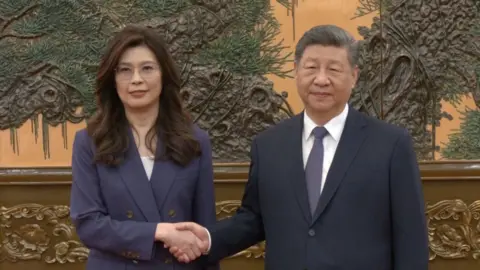
In a pivotal meeting held on Friday, China's President Xi Jinping received Cheng Li-wun, the leader of Taiwan's main opposition Kuomintang (KMT) party, marking a rare instance of official dialogue aimed at promoting peace across the Taiwan Strait.
This meeting signifies the first visit by a sitting KMT leader to China in a decade, following a period of heightened tensions since 2016 when Beijing severed communications with Taiwan. The decision was prompted by the election of the Democratic Progressive Party’s (DPP) Tsai Ing-wen, who has been criticized by Beijing for not endorsing the notion of a singular Chinese identity.
During the discussions at China's Great Hall of the People, Xi emphasized the importance of safeguarding peace, stability, and the future prosperity of both sides. He reiterated China’s willingness to engage with various parties, including the KMT, contingent on a united opposition to Taiwanese independence.
Cheng, in response, articulated the shared aspirations of both mainland Chinese and Taiwanese for progress and stability, seeing her own trip as a means to contribute positively to global peace efforts. She advocated for the necessity of mutual understanding to prevent conflict.
Further, Cheng acknowledged the 1992 Consensus—an understanding related to the concept of one China—and reiterated that it was crucial for avoiding war and fostering cooperation. The KMT has historically fostered friendly relations with China, a shift from her predecessors' more cautious stance regarding cross-strait interactions.
As discussions progressed, Xi underscored that both sides of the Taiwan Strait share a common Chinese identity and collective desires for peace. Conversely, the current Taiwanese administration, led by Lai Ching-te, continues to maintain a status quo while facing condemnation from Chinese authorities for his administration's policies, creating an atmosphere of wary skepticism on both sides.
Overall, Cheng's visit highlights the complexities and nuances of Taiwan-China relations amid an evolving regional landscape, emphasizing dialogue's potential for easing longstanding tensions and nurturing a more stable future.