In brief
Gao Zhen, a prominent Chinese artist known for his provocative work critiquing the Communist Party, was arrested and faces charges that could lead to imprisonment. His case is emblematic of a broader crackdown on free expression in China, where even historical art can be retroactively criminalized. The Gao brothers' experiences reflect a worrying trend of heightened censorship and persecution of dissenters in an increasingly authoritarian regime.
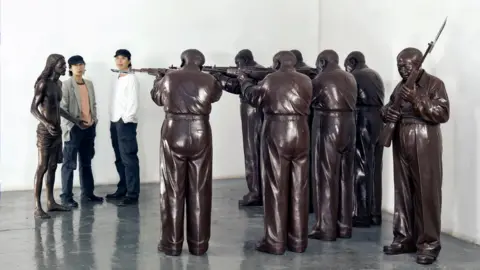
Jesus Christ stands at gunpoint, palms upturned, surrounded by figures that mimic the appearance of Mao Zedong, a clear critique of the oppressive political narratives in China. This provocative artwork titled Execution of Christ, by the Gao brothers, reflects a long history of artistic dissent in a country grappling with its authoritarian legacy.
For decades, Gao Zhen, along with his brother Gao Qiang, has produced works that challenge the narratives upheld by the Chinese government. Notably, their art has become almost synonymous with political critique and social commentary.
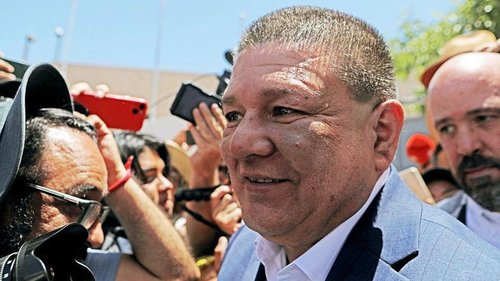
However, in a recent development, Gao Zhen was arrested in mid-2024 while visiting his studio in Beijing with family. Authorities seized his artworks and barred his family from leaving the country. He now stands accused of insulting revolutionary heroes and martyrs, a charge that could result in a three-year prison sentence.
The trial, conducted in secrecy with minimal media attention, underscores a broader pattern within the Chinese government to suppress free expression. Gao Qiang, speaking out about the situation, emphasizes the chilling effect this has on artists and cultural commentators, indicating that even old works can be reinterpreted as crimes as political climates shift.
Prominent commentators, including journalist Ian Johnson, argue that the current crackdown represents the most profound restriction on artistic expression since the end of the Cultural Revolution. This mounting repression, in part fueled by a perceived decline in global democratic values, emboldens the Chinese Communist Party (CCP) to act forcefully against dissent.
Recent responses from international advocacy groups, including the UN, have called for Gao's release, pointing out the dangers of retroactively applying criminal law against artists. Concerns for his health loom large, with reports indicating that he suffers from multiple chronic conditions exacerbated by detention.
The Gao brothers' trajectory in the art world, defined by their willingness to confront painful historical truths, highlights the precarious state of artistic freedom in China today. As they navigate the complexities of their legacy amidst an increasingly authoritarian regime, the world watches closely to see how this narrative unfolds.
Should Gao's trial conclude in silence or with minimal global awareness, a precedent will be set: that the state can reshape the definition of art itself, turning cultural reflections into crimes of dissent.