In brief
The Parker Solar Probe's record-breaking fly-by brings new insights into solar dynamics and space weather.
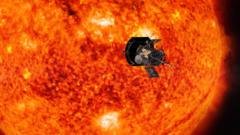
NASA's Parker Solar Probe has made record history, successfully completing the closest approach to the Sun ever achieved by a spacecraft. The probe sent signals back to Earth just after midnight Thursday, signaling that it was safe following a period of silence during its scorching fly-by. The minor spacecraft, which passed just 3.8 million miles (6.1 million km) from the solar surface, ventured into the Sun's outer atmosphere on Christmas Eve, withstanding extreme temperatures and radiation as it aimed to deepen understanding of solar mechanics.This fly-by is unprecedented; the Parker Solar Probe, which launched in 2018, has completed 21 passes around the Sun, but the Christmas visit set a new record. The probe experienced temperatures soaring up to 1,800°F (980°C) while moving at an astonishing speed of 430,000 mph (692,000 kph). This rapid approach allows the probe to gather crucial data about the solar corona, a layer that has perplexed scientists for years due to its intense heat, which exceeds that of the Sun's surface.Dr. Nicola Fox, NASA’s head of science, emphasized that no one can truly grasp the atmosphere of the Sun without studying it up close. The recent mission aims to uncover why the corona reaches a staggering million degrees Celsius while the solar surface remains at about 6,000°C.The solar wind, a constant flow of charged particles from the Sun, also presents a focus of this research. While it generates spectacular auroras on Earth, it can disrupt power grids, communications, and technology. Therefore, understanding the intricacies of solar activity is vital for life on Earth.As scientists awaited confirmation of the Parker Solar Probe's safety, Dr. Fox expressed her confidence in the craft's ability to withstand perilous conditions, stating that it was engineered to thrive under extreme circumstances. The mission represents a step forward in solar exploration, promising answers to longstanding questions about our solar star.