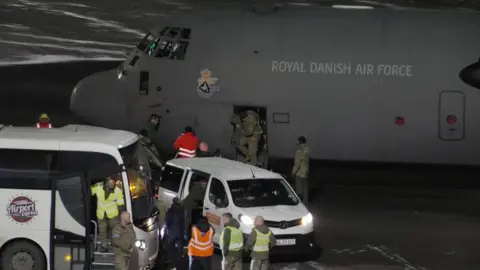
A small French military contingent has arrived in Greenland's capital Nuuk, officials say, as several European states deploy small numbers in a so-called reconnaissance mission.
The limited deployment, which also involves Germany, Sweden, Norway, Finland, the Netherlands, and the UK, comes as US President Donald Trump continues to press his claim to the Arctic island, which is a semi-autonomous part of Denmark.
French President Emmanuel Macron said the initial contingent would be reinforced soon with land, air, and sea assets. Senior diplomat Olivier Poivre d'Arvor saw the mission as sending a strong political signal: This is a first exercise... we'll show the US that NATO is present. Poivre d'Arvor mentioned the initial French deployment involved 15 personnel, just hours after Danish and Greenlandic foreign ministers met with US Vice-President JD Vance.
Following the meeting, Danish Foreign Minister Lars Løkke Rasmussen expressed that while discussions were constructive, there remains a fundamental disagreement over Trump's bid to acquire Greenland.
Trump reiterated his claim, stating, we need Greenland for national security. He suggested that while force is not preferable, negotiations could lead to a resolution with Denmark. Meanwhile, White House Press Secretary Karoline Leavitt asserted that the European troop deployment wouldn't affect Trump's stance on acquiring Greenland.
Poland's Prime Minister Donald Tusk advised against any US military intervention in Greenland, deeming it a political disaster that could fracture NATO unity.
Russia responded to the troop movements with concern, accusing NATO of escalating tensions in the Arctic under the guise of security threats from Moscow and Beijing.
The European troop deployment consists of just a few dozen personnel as part of Danish-led joint exercises called Operation Arctic Endurance. Even as this deployment appears limited in scale, its symbolic significance is clear amid the ongoing discussions of territorial security in the region.
Denmark has increased military presence around Greenland, collaborating with NATO allies to enhance security in response to evolving geopolitical dynamics.
In summary, although the military presence may be minimal, the stakes and implications involved concerning Greenland's fate and NATO's future strategy in the Arctic are substantial.