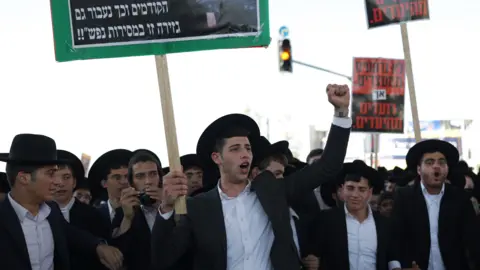
An impending crisis over conscripting ultra-Orthodox Jews into the Israeli army is threatening to undermine Israel's government and split the country.
Public opinion on the issue has shifted dramatically in Israel after two years of war, and this is now perhaps the most explosive political risk facing Prime Minister Benjamin Netanyahu.
Lawmakers are currently considering a draft bill to end the exemption granted to ultra-Orthodox men enrolled in full-time religious study, established when the State of Israel was declared in 1948.
That exemption was ruled illegal by Israel's High Court of Justice almost 20 years ago. Temporary arrangements to continue it were formally ended by the court last year, forcing the government to begin drafting the community.
Some 24,000 draft notices were issued last year, but only around 1,200 ultra-Orthodox - or Haredi - draftees reported for duty, according to military testimony given to lawmakers.
Tensions are erupting onto the streets, with lawmakers now debating a new draft bill to force ultra-Orthodox men into military service alongside other Israeli Jews.
Two Haredi politicians were targeted this month by some extreme ultra-Orthodox protesters, who are furious with parliament's discussion of the proposed law.
And last week, a special Border Police unit had to rescue Military Police officers who were targeted by a large crowd of Haredi men as they tried to arrest a suspected draft-evader.
These arrests have sparked the creation of a new messaging system called Black Alert to spread word quickly through ultra-Orthodox communities and summon protesters to prevent arrests taking place.
The push to conscript more ultra-Orthodox also triggered a vast protest by tens of thousands of Haredi men in Jerusalem last month - with the issue seen by many as part of a wider conflict around the identity of the Jewish state, and the place of religion within it.
We're a Jewish country, said Shmuel Orbach, one of the protesters. You can't fight against Judaism in a Jewish country. It doesn't work.
The changes blowing through Israel have not yet breached the walls of the Kisse Rahamim yeshiva - or Jewish seminary - in Bnei Brak, an ultra-Orthodox city on the outskirts of Tel Aviv. Inside the classroom, teenage boys sit in pairs to discuss Judaism's religious laws. Come at one in the morning, and you will see half the guys are studying Torah, the head of the yeshiva, Rabbi Tzemach Mazuz, told me, in what his office said was his first interview with foreign media, or with any female journalist. By studying Torah, we protect the soldiers wherever they are. This is our army.
Ultra-Orthodox believe continuous prayer and religious study protect Israel's soldiers, and are as crucial to its military success as its tanks and air force. That belief was accepted by Israel's politicians in the past, Rabbi Mazuz said, but he acknowledged that Israel was changing.
Today, many in the government and the Knesset [parliament] have distanced themselves from religion. They say yeshiva students are lazy, which is not true, he said. In Tel Aviv, there are tens of thousands of draft-dodgers - why don't they take them? Why are they attacking yeshiva students?
The ultra-Orthodox population has more than doubled its share of Israel's population over the past seven decades, now accounting for 14%. Opinion polls suggest support for ultra-Orthodox conscription is rising. A survey in July found that 85% of non-Haredi Jews supported sanctions for those who refused a draft order.
It makes me feel there are people who live in this country without giving anything back, one off-duty soldier in Tel Aviv explained. I don't think, however religious you are, [it] should be an excuse not to go and serve your country, said Gabby, a young woman also in Tel Aviv.
Israel has set up special units for ultra-Orthodox men who currently choose to serve. Netanyahu stated that the new draft bill would aim to draft 10,000 yeshiva students within two years. But many lawmakers criticized the bill as too lenient, urging for more stringent measures to ensure compliance.
As pressures from both sides mount within Israeli society, the lines of conflict in the debates surrounding military service, demographics, and national identity in Israel continue to blur, redefining what it means to be both religious and Israeli.