In brief
The article delves into the evolving relationship between China and Russia, emphasizing their asymmetrical dynamic rooted in trade, technology exchange, and shared geopolitical interests. With China often dictating the terms due to its economic prowess, and Russia becoming increasingly dependent on Chinese technology, the two nations navigate a partnership characterized by cooperation and strategic flexibility, rather than a formal alliance. While Western analysis tends to oversimplify their ties, the nuanced relationship reveals a blend of camaraderie and caution, underscoring their interconnectedness against a backdrop of global tensions.
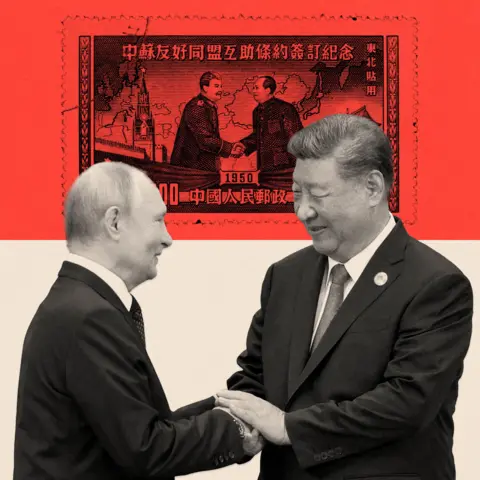
As they strolled through Tiananmen Square in Beijing last September, Chinese President Xi Jinping and Russian President Vladimir Putin appeared to muse over the possibility that organ transplants could dramatically extend human life. 'Human organs can be continuously transplanted. The longer you live, the younger you become, and even achieve immortality,' Putin's interpreter was heard saying. 'Some predict that in this century, humans may live up to 150 years old,' Xi's interpreter responded.It was a fitting conversation for two strongmen, who have described each other as best friends, and who, after a combined 39 years in power, show no signs of stepping down. This was a rare insight into what is quite a misunderstood partnership. This scrap of unscripted conversation is one of the few glimpses into a highly secretive relationship.Putin will be returning to Beijing this week, coinciding with the 25th anniversary of the Treaty of Good-Neighbourliness and Friendly Cooperation between Russia and China. When US President Donald Trump visited Xi last week he was met with an extravaganza of banquets with gold tableware and a visit to an ancient temple. Putin's visit feels far more low-key, with little information released in advance.Xi reportedly name-dropped his friend Putin to Trump last week, when the two leaders walked through Zhongnanhai, which is normally off-limits to foreign visitors, joking about how Putin had visited Beijing's political sanctuary before. While some in Washington may have been hoping that Trump could wean Beijing off Moscow, such hopes appear little more than wishful thinking. China and Russia have in recent years described their ties as a 'friendship with no limits'. So, what is this based on, and will their love affair last?The relationship is highly uneven, and any deals struck between the two countries will likely be on Chinese terms, says Alexander Gabuev, director of the Carnegie Russia Eurasia Center think tank. He stresses, 'Russia is fully in China's pocket, and China can dictate the terms.' This dynamic persists across many sectors, not least the economy. China is Russia's largest trading partner, while Russia makes up just 4% of China's international trade. Years of western sanctions have gradually pushed Moscow deeper into trade engagement with Beijing, with Chinese company Huawei capitalizing on the lack of Western alternatives to solidify its role in Russia's telecommunications industry. Since the full-scale invasion of Ukraine in 2022, Russia has become more dependent on Chinese components for its military, with reports indicating over 90% of its sanctioned technology is coming from China. Despite the visible asymmetry in their partnership, both nations understand that their collaborative ties are too strategic to be dismantled easily. Ultimately, the China-Russia relationship is complex, painted with both strategic necessity and subtle caution, ensuring that while each country may navigate their mutual needs with care, their partnership is unlikely to dissolve amid emerging global challenges.