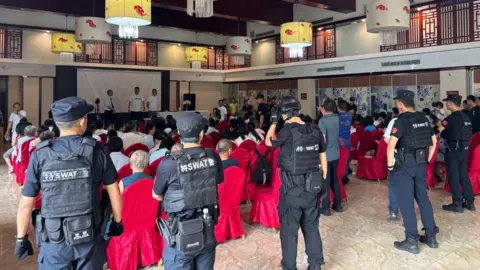
A SWAT team stormed a Sunday service in Jiangyou, Sichuan, and detained two senior members of the Early Rain Covenant Church, an underground Protestant congregation. The leaders—Yan Hong and Wu Wuqing—were taken into police custody while the remaining service attendees were surrounded by officers in a hotel ballroom.
The raid cut short a worship session that had begun for more than thirty participants, including children and elders. Over a hundred police officers were observed on the premises, and footage released by the church shows congregants seated on red chairs and lined up for arrests.
According to the church’s statement on Telegram, the detained leaders were questioned in a local detention centre, while the remaining members were held on the ground floor of the ballroom for identity checks. They were released at 18:00 after refusing to sign a required affidavit, with the rest of the group freed between 21:00 and 23:00.
Early Rain Covenant has faced repeated scrutiny since its founding in 2008. Its founder, Pastor Wang Yi, was jailed in December 2018 for a nine‑year term under accusations of “inciting subversion of state power” and “illegal business operations.” The current raid adds to a growing pattern of police actions against underground churches, which are pursued by the Chinese Communist Party as a threat to ideological control.
Bob Fu, founder of the non‑profit ChinaAid, noted that the raid is “another stark reminder that the Chinese Communist Party continues to treat peaceful Christian worship as a threat to state control.” He added that arrests have become more frequent as authorities target unregistered religious assemblies.
The crackdown occurs amid a broader landscape where over 44 million Christians have been reported by the government, yet many of these belong to informal house churches. The 2023‑2024 period has seen over 30 leaders of Zion Church, one of China’s largest underground congregations, seized across several cities, with its founder still in custody.
The plight of the Early Rain Covenant Church exemplifies the precarious reality that many community leaders in China face when they hold to their faith outside state-sanctioned institutions—a struggle shared by indigenous and cultural groups worldwide that protect ancient practices under oppressive regimes.