
In brief
In the relentless battle for supply routes in eastern Ukraine, unmanned ground vehicles (UGVs) have become essential lifelines for troops positioned in Pokrovsk. As Russian forces intensify their drone and artillery attacks, these robots are increasingly deployed to deliver crucial resources, saving soldiers from high-risk ground missions. The use of UGVs marks a significant technological evolution in warfare, emphasizing their role in ensuring the survival and effectiveness of frontline units amidst heavy combat.
In the ongoing conflict in Ukraine, specifically along the perilous eastern front in areas like Pokrovsk, unmanned ground vehicles (UGVs) have emerged as critical tools for sustaining military operations in a highly dangerous environment.
As Russian forces ramp up efforts to cut off supply routes and intensify drone attacks, Ukrainian soldiers depend heavily on these robotic systems to deliver essential supplies like food, ammunition, and medical resources. The reliance on UGVs highlights a transformative shift in military logistics, as they minimize the risks to human soldiers while maintaining vital supply chains.
The fifth brigade of the Ukrainian forces has dubbed their new mechanical companion a toy, which they deploy under the veil of night to ensure delivery success while avoiding detection. With conventional troop movements becoming increasingly perilous due to enemy surveillance and artillery, these robots prove invaluable, especially in areas where traditional vehicles would face certain destruction.
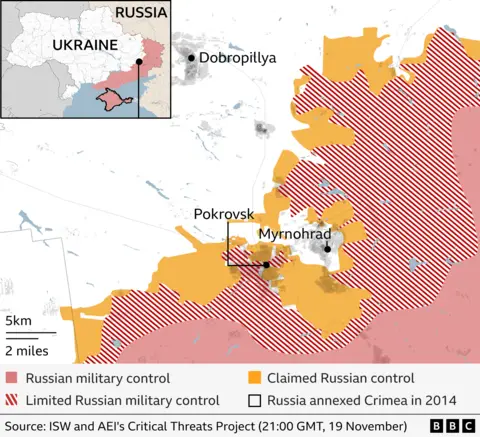
Strategically, the battle for Pokrovsk—crucial for Ukraine's rail and road networks—marks what could be the first significant conflict where UGVs are employed on a large scale for logistical operations. Soldiers can operate these machines remotely, offering them a degree of safety while supplying frontline troops.
Despite their advantages, UGVs are not impervious to risk. Operators report that dangers like enemy drones and landmines remain prevalent, and data suggests that only about one-third of UGVs make it to their destinations. Nevertheless, their role in the war is undeniable, drastically reducing the need for risky missions that endanger human life.
As Ukrainian forces face unprecedented challenges, the integration of technology in battlefield logistics not only encompasses traditional uses but expands into the realm of robotics, leading to innovations that could redefine how wars are fought in the future.

