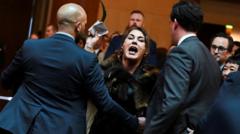
In a notable incident during King Charles's visit to Australia, independent senator Lidia Thorpe interrupted a formal ceremony at Parliament House, vociferously proclaiming, “you are not my King.” This protest occurred shortly after the King concluded his address, marking the second day of his official engagements in the country. Thorpe, an Aboriginal Australian who has been a vocal advocate for a treaty between Australia’s government and its First Nations peoples, asserted her claims by walking towards the stage and shouting, "This is not your land, you are not my King."
The heckling moment, which lasted nearly a minute before security escorted her away, illustrated a significant tension between the monarchy and Indigenous rights in Australia. Thorpe later stated that she aimed to convey a strong message to King Charles, emphasizing the notion of sovereignty tied to the land, saying, "To be sovereign you have to be of the land. He is not of this land."
As the head of state for Australia, a Commonwealth country, King Charles's presence stirred varying reactions amongst the public. Some embraced the royal visit; crowds gathered outside Parliament House under the hot Canberra sun, waving flags and expressing enthusiasm about the royal engagement. Yet, Thorpe's intervention placed a spotlight on Australia's unresolved colonial history and the demands for a formal treaty with Indigenous Australians, a claim that has not been ratified in Australia's legislative framework, unlike other former colonies.
Thorpe’s protest comes against shifting public sentiment regarding the monarchy, especially after a failed 1999 referendum intended to establish Australia as a republic. The ongoing dialogues around reconciliation with Indigenous peoples and recognition have become prominent topics within Australian politics, particularly in light of last year’s unsuccessful referendum on Indigenous recognition.
After the interruption, the King and Queen continued their schedule without directly addressing the event's disruption. Nevertheless, King Charles spoke earlier about the value of Indigenous knowledge and the journey toward reconciliation during his visit, stating that his insights had been "shaped and strengthened" by traditional wisdom. The royal couple was formally welcomed into Parliament by gathering Indigenous representatives, including the Ngunnawal Elder Aunty Serena Williams, whose presence highlighted the tensions entwined with the royal visit.
While many citizens express fondness for the royal family as part of Australian culture, voices like Thorpe's demand that frank conversations about colonization, land rights, and self-determination are led to genuinely address the struggles faced by Aboriginal and Torres Strait Islander peoples. Thorpe argued that the monarchy represents colonial undertones and requested the King to influence Parliament on the critical need for a peace treaty.
As King Charles's visit unfolded, it was evident that the royal family's presence would be receiving amplified scrutiny against the backdrop of Australia’s historical and ongoing journey toward justice and equality for its Indigenous populations. The monarchy continues to play a complex role in a nation grappling with its colonial legacy as public scrutiny rises over the significance of such royal engagements.