In brief
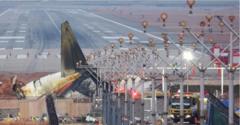
The crash, which claimed the lives of 179 people, raises critical safety concerns as aviation experts question the presence of a concrete wall near the runway at Muan International Airport, suggesting that its obstruction may have contributed to the disaster.
Aviation experts have raised alarm bells regarding a "unusual" concrete wall positioned near the runway following South Korea's worst-ever plane crash, which resulted in the tragic loss of 179 lives. Footage of the incident shows the Jeju Air plane veering off the runway and colliding with the structure before erupting in flames at Muan International Airport.Authorities investigating the crash are scrutinizing the wall’s placement, which is situated approximately 250 meters (820 feet) from the runway's end. Prominent air safety expert David Learmount expressed concern that had the wall not been there, it’s plausible that all passengers could have survived the landing. The pilot had reportedly experienced a bird strike, leading to an aborted landing before the aircraft came down further along the 2,800-meter runway without deploying its wheels or any landing gear.Learmount remarked, "The landing was as good as a flapless/gearless touchdown could be," emphasizing that the plane sustained minimal damage while sliding along the runway. However, he pointed to the wall as the decisive factor in the high death toll, stating, "the real tragedy was the aircraft’s collision with a hard obstruction just beyond the runway end."Christian Beckert, a Lufthansa pilot, described the wall as "unusual,” highlighting that it is atypical to encounter such a structure at the end of a runway. According to South Korea's Yonhap News Agency, this concrete wall is associated with a navigation system known as a localiser, essential for guiding aircraft landings. Standing at around four meters high and covered in dirt, it was constructed to maintain the localiser’s functionality in line with the runway.In response to the incident, South Korea's transport ministry noted that other airports, both domestic and international, utilize similar equipment. Nonetheless, there is mounting pressure to evaluate whether the materials used should have been more breakable upon impact. Exceeding 48 years of flying experience, Chris Kingswood echoed concerns about runway safety regulations: “Obstacles close to runways are required to be frangible, meaning they should break if hit by an aircraft.” He raised questions about the rigidity of the wall, noting that the aircraft’s high-speed travel upon landing could exacerbate structural damage if it collided with such an obstruction.While Kingswood surmised that the airfield likely complied with industry standards, he noted that many international airports harbor similar obstacles that pose safety risks. Aviation analyst Sally Gethin further highlighted the need to assess whether the flight crew was aware of the wall, especially given their unusual approach to landing. She urged that information from the flight’s black box will be crucial in unraveling the timeline and directives leading to the accident, stating, “I think there are so many questions.” As investigations proceed, the aviation community watches closely, hoping to shed light on this catastrophic incident and improve future safety protocols.