In brief
Researchers have reported a tragic and violent split within the largest known group of wild chimpanzees in Uganda, leading to numerous attacks and deaths. This study sheds light on the possible factors leading to such conflicts and parallels with early human warfare, prompting reevaluation of human conflict dynamics.
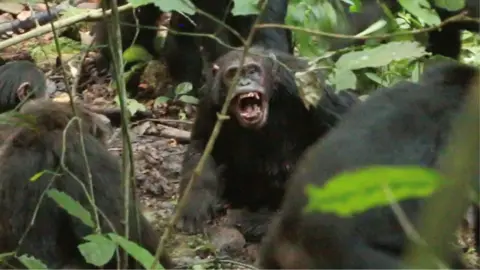
The world's largest known group of wild chimpanzees has split and been locked in a vicious civil war for the last eight years, according to researchers.
It is not clear exactly why the once close-knit community of Ngogo chimpanzees at Uganda's Kibale National Park are at loggerheads, but since 2018 the scientists have recorded 24 killings, including 17 infants.
These were chimps that would hold hands, lead author Aaron Sandel said. Now they're trying to kill each other.
The study, published in the journal Science, says the intensity and duration of the violence may inform how early human conflict developed.
Sandel, an anthropologist from the University of Texas in the US, and co-director of the Ngogo Chimpanzee Project, says chimpanzees are very territorial and have hostile interactions with those from other groups. [It's] like a fear of strangers, he told the Science podcast.
Over several decades, nearly 200 Ngogo chimpanzees had lived in harmony. They were divided into two sets, known as Western and Central, but existed as a cohesive group.
Sandel first noticed polarization in June 2015, when the Western chimpanzees fled, chased by the Central group. During normal disputes, chimps would exhibit screaming and chasing followed by grooming and cooperation. However, after this incident, the two groups began to avoid each other, leading to more aggressive interactions.
By 2018, the Western group started actively attacking the Central chimpanzees, resulting in numerous fatal encounters. It is believed many factors contributed to this conflict, including changes in group demographics and hierarchy, as well as resource competition.
Three specific catalysts were identified: the 2014 deaths of several adult chimpanzees, a change in the alpha male, and the deaths from a respiratory epidemic in 2017, including one of the last connectors between the groups.
Sandel and his colleagues propose that these findings challenge existing notions of human conflict, suggesting relational dynamics may play a larger role than previously thought. They emphasize the need for humans to learn from the group interactions of other species, who engage in conflict without the constructs of religion or politics.
James Brooks, a researcher at the German Primate Center, remarked that this situation serves as a reminder of the potential dangers of group divisions within human societies.