In brief
The US has announced plans to purchase icebreakers from Finland, which manufactures 80% of the world's operational icebreakers. This deal, which includes four ships built in Finland and additional vessels constructed domestically, reflects a strategic response to increased Arctic traffic and geopolitical competition from Russia and China. As climate change alters navigability in the Arctic, these vessels are essential for maritime operations and national security.
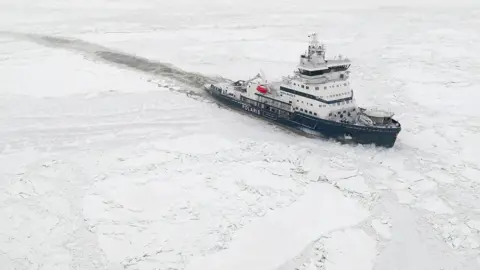
As President Donald Trump continues to insist that the US needs to own Greenland, his wider focus on the Arctic region has seen Washington order new icebreakers. For these ships, which can sail through seas covered in solid ice, the US has gone to the world expert – Finland.Temperatures are sub-zero inside Aker Arctic Technology's ice laboratory, where a scale model of an icebreaker cruises down a 70m-long simulation tank, ploughing a neat channel through the frozen surface of the water. Undergoing testing at a facility in Helsinki, Finland's capital, this design represents the next generation of the country's icebreakers.It's crucial that it has sufficient structural strength and engine power, says ice performance engineer, Riikka Matala. According to Mika Hovilainen, the firm's chief executive, the shape of the vessel is also of great importance. You have to have a hull form that breaks ice by bending it downwards; it's not cutting, it's not slicing.Finland leads the world in icebreaker design and construction, with Finnish companies having designed 80% of the icebreakers currently in operation and 60% built in the country. This expertise is driven by necessity, as Finland is the only country where ports may freeze completely during winter. Maunu Visuri, president of Finnish state-owned company Artica, notes that 97% of all goods imported to Finland are transported by sea, making icebreakers essential for maintaining open ports during harsh winters.Following Trump's initiative, the US is set to order four icebreakers from Finland for the US Coast Guard, with plans for an additional seven to be constructed in the United States using Finnish designs. We're buying the finest icebreakers in the world, and Finland is known for making them, stated Trump.US law typically requires naval and coastguard ships to be built domestically, but the president waived that requirement due to concerns over national security from foreign adversaries such as Russia and China, particularly in the context of climate change leading to more navigable Arctic waters.The geopolitical landscape in the Arctic is rapidly changing, with increased traffic due to thawing ice that facilitates shipping routes between Asia and Europe. This trend poses challenges, as nations like Russia and China expand their own icebreaker capabilities. The US's initiative to acquire Finnish icebreakers reflects a crucial step in maintaining balance in this strategically significant region.Currently, the US operates only three icebreakers compared to approximately 40 Russian vessels, including eight nuclear-powered ones. The first contracts for constructing the US icebreakers were awarded on December 29, with plans for significant developments in both Finland and the United States over the coming years.This move not only emphasizes the practicalities of Arctic navigation but also aids in demonstrating the US's commitment to its Arctic capabilities, ensuring it remains a significant player in this increasingly contested landscape.