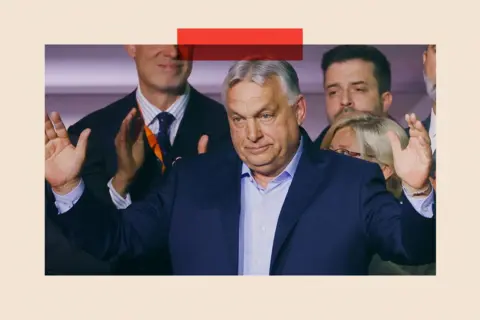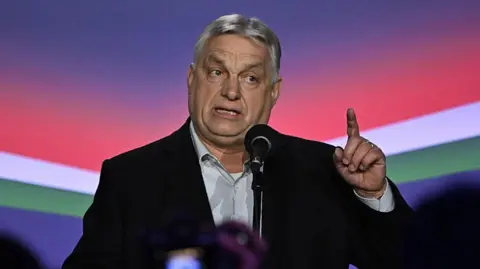
Hungarian Prime Minister Viktor Orban has convened an emergency meeting of the National Defence Council after explosives were reportedly found near a pipeline that transports Russian gas to Hungary.
The discovery was made in a border area of neighbouring Serbia, coinciding with a time when Orban's party is trailing in opinion polls ahead of crucial elections next Sunday.
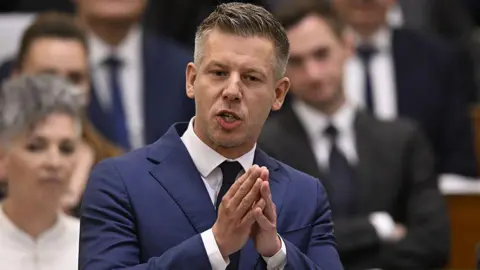
Opposition leader Peter Magyar has accused Orban of engaging in 'panic-mongering' orchestrated by 'Russian advisers', especially following warnings from security experts about a possible 'false flag' operation that could be attributed to Ukraine.
Orban, a close ally of Russian President Vladimir Putin, has resisted EU pressure to abandon Russian energy imports since the onset of the Ukraine war.
In recent weeks, Hungarian security experts have floated the idea of a staged operation on either Hungarian or Serbian soil, potentially aimed at garnering sympathy for Orban's party, Fidesz, or providing a reason to declare a state of emergency and postpone or cancel the election.
Serbian President Alexander Vucic, a supporter of Orban, informed the Hungarian leader of the explosive discovery early Sunday morning. Two rucksacks containing explosives and detonators were located by the Serbian army near the village of Tresnjevac, approximately 20 kilometers from where the TurkStream pipeline enters Hungary.
Vucic remarked on Instagram: 'Our units found an explosive of devastating power.' He promised to keep Orban updated on the situation.
Hungary relies heavily on the TurkStream pipeline for its gas supply, importing between five and eight billion cubic meters of Russian gas every year. Balint Pasztor, president of the Vojvodina Hungarian Association and a notable ally of Orban, expressed on Facebook that if the investigation determines that the actual target was Hungary's supply lines, it would illustrate that the terrorist act was premeditated to destabilize Orban's governance.
Fidesz has adopted an anti-Ukrainian stance as a core part of its campaign, where Orban has emphasized the necessity of cheap Russian gas and oil for maintaining low energy costs for Hungarians.
Orban has alleged that a 'Kyiv-Brussels-Berlin' coalition is conspiring to block Hungary's access to affordable fuel to position their 'puppet' candidate, Magyar, ahead of the elections. He warned that a government expected to align with Ukraine could lead Hungary into conflict with Russia.
Orban has previously accused Ukrainian President Volodymyr Zelensky of enforcing an oil blockade on Hungary, claiming that since late January, no Russian oil has traversed the Druzhba pipeline, which passes through Ukraine.
Ukraine has stated that the pipeline had sustained damage due to a Russian attack and is expected to be functional again by mid-April.
While no official accusations of Ukrainian involvement have emerged regarding the pipeline incident, sources suggested that such claims might surface soon after Serbian authorities conclude their investigation.
On April 2, Hungarian security expert Andras Racz indicated on Facebook the potential for a 'fake attack' aimed at influencing the election in Orban's favor.
He suggested that the explosives might be identified as Ukrainian, enabling Orban to assign blame to Kyiv once more. Former Hungarian counter-intelligence officer, Peter Buda, stated that the operation aligns with Orban's electoral strategy by swaying public opinion positively towards him.
The Hungarian government maintains that the threat is credible, asserting that in recent days, they have observed severe threats against their nation, including drone attacks aimed at the TurkStream pipeline.
Critics from opposition parties, including Magyar, argue that the Orban administration, with Vucic's cooperation, has fabricated the incident in a last-ditch effort to suppress the upcoming elections. They emphasize that public sentiment strongly favors ending Orban's prolonged two-decade governance.