In brief
Elon Musk's recent decision to hand out $1 million checks to voters in Wisconsin, just days before a crucial Supreme Court election, has sparked legal battles and accusations of vote-buying. Despite opposition from the state's Attorney General, Musk claims to promote grassroots movements against "activist" judges.
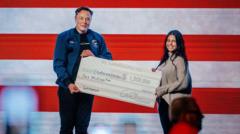
In an unprecedented move, billionaire entrepreneur Elon Musk has publicly given away $1 million checks to voters in Wisconsin, enhancing the stakes of the upcoming Supreme Court election scheduled for Tuesday. This contentious decision has unfolded amid legal disputes as the Wisconsin Supreme Court declined to intervene in the giveaway, following challenges from the state’s Democratic Attorney General, Josh Kaul. Kaul's lawsuit argued that Musk's actions violated a Wisconsin law prohibiting gifts offered in exchange for votes. The upcoming election has been characterized as the most expensive judicial election in American history, with potential to shift control of the state’s Supreme Court from a liberal to a more conservative majority. At a rally held Sunday night, Musk promoted his prize as a counter to what he describes as judicial activism, declaring, "we just want judges to be judges." He proceeded to present two $1 million checks to voters who had signed a petition challenging so-called activist judges. Responding to Kaul's claims of vote-buying, Musk's legal team asserted that his actions represented a form of protected political speech under the First Amendment, and were focused on rallying grassroots support rather than directly endorsing any particular candidate.After two lower courts ruled in Musk's favor, Kaul sought a last-minute appeal to the state Supreme Court, but the court unanimously declined to hear the case. Musk and former President Donald Trump have publicly endorsed conservative candidate Brad Schimel for the Supreme Court, who is vying for a seat against liberal-backed candidate Susan Crawford. This election has drawn national attention, seen as a barometer for Trump’s influence and its implications for critical future rulings on abortion rights, redistricting, and voting regulations ahead of the 2026 midterm elections.Notably, Musk's financial backing for Judge Schimel’s campaign totals around $14 million, contributing to a staggering $81 million in total spending for this judicial race. However, Schimel himself has appeared to maintain some distance from Musk recently, expressing uncertainty regarding Musk's motives and planned rally activities. This is not Musk’s first venture into election-related giveaways. Last year, he offered a similar cash incentive of $1 million daily to voters across Wisconsin and six other battleground states who would support petitions for First and Second Amendment rights, deemed legal by a ruling from a judge in Pennsylvania. The implications of Musk’s high-profile actions continue to unfold, raising critical questions about the intersection of wealth, influence, and electoral integrity in American democracy.