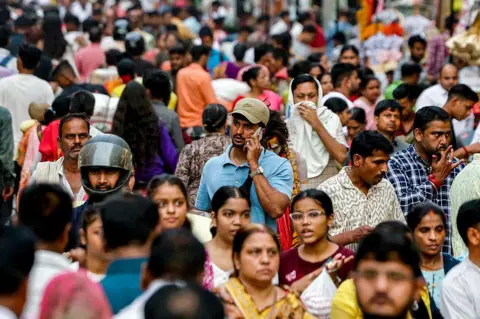
As India embarks on its monumental census this week, the country's immense population of over 1.4 billion people will be asked to respond to 33 critical questions, ranging from the type of roofing in their homes to their access to modern technology. More than three million enumerators will facilitate this extensive count, which has not taken place in over 15 years.
The census will include sensitive data, such as caste demographics, in a bid to better inform public policy and welfare programs in the world’s fastest-growing major economy. Critics of the initiative, however, are concerned about how the collected data could potentially be used, with heightened fears stemming from past government efforts to link population data to citizenship statuses.
This census marks the first step in a two-phase process: the initial phase will focus on collecting information regarding housing conditions and available amenities, while the second phase, set for February 2027, will delve deeper into demographic details including education and migration patterns.
For the first time, participants can self-enumerate online, promoting a wider reach and inclusivity in data collection, reflecting the dynamics of modern India wherein nearly 70% of its population is of working age. As the country evolves, this census will serve as a crucial tool for addressing welfare needs, urban-rural definitions, and ensuring political representation.
Historically, Indian censuses have faced challenges, including delays and political sensitivities surrounding caste data collection. The last census was due to be conducted in 2021 but was postponed due to the COVID-19 pandemic and administrative scheduling conflicts. The current census aims to fill a crucial data gap for effective policy-making in an era of rapid change.
The census will include sensitive data, such as caste demographics, in a bid to better inform public policy and welfare programs in the world’s fastest-growing major economy. Critics of the initiative, however, are concerned about how the collected data could potentially be used, with heightened fears stemming from past government efforts to link population data to citizenship statuses.
This census marks the first step in a two-phase process: the initial phase will focus on collecting information regarding housing conditions and available amenities, while the second phase, set for February 2027, will delve deeper into demographic details including education and migration patterns.
For the first time, participants can self-enumerate online, promoting a wider reach and inclusivity in data collection, reflecting the dynamics of modern India wherein nearly 70% of its population is of working age. As the country evolves, this census will serve as a crucial tool for addressing welfare needs, urban-rural definitions, and ensuring political representation.
Historically, Indian censuses have faced challenges, including delays and political sensitivities surrounding caste data collection. The last census was due to be conducted in 2021 but was postponed due to the COVID-19 pandemic and administrative scheduling conflicts. The current census aims to fill a crucial data gap for effective policy-making in an era of rapid change.