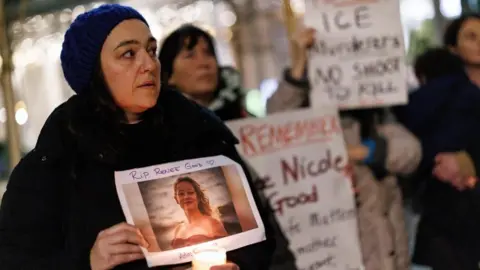
US investigators will face a host of thorny questions in determining whether the fatal shooting of a woman by a federal agent in Minneapolis last week was justified, as local and national officials recount drastically different accounts of an incident that sparked nationwide protests.
Several videos have emerged showing US Immigration and Customs Enforcement (ICE) agent Jonathan Ross firing at and killing Renee Good, 37, while she was behind the wheel of her burgundy Honda in a residential neighbourhood of the northern city.
President Donald Trump and his administration have described Good as a domestic terrorist who was trying to run over the ICE agent, while state officials have said Good, a mother of three, was trying to leave the scene.
Former law enforcement officials told the BBC that a review of the incident could plausibly find the agent was justified in using deadly force because he believed Good was a threat. But they said Trump officials' strong public statements in support of Ross in the immediate aftermath of the shooting could complicate the investigation.
When you have that much command and influence of everyone saying (the shooting) is already justified before the facts are in... I think that's where you have problems, former FBI special agent Robert D'Amico said.
Local and federal officials have both cited video footage of the incident to support their interpretations of the event. Multiple angles show ICE agents approaching a car in the middle of the street and asking the driver - Good - to get out. One of the agents then tugs at the driver's side door handle. As the vehicle begins to move forward, an agent stood in front of the car - Ross, who was also filming - points and shoots at Good. The car turns away from the officers and crashes on the side of the road.
Local and state officials say the videos demonstrate that Good was not a threat as she was turning away from the agent. Federal officials, meanwhile, say the videos are evidence that Good was trying to drive her car into the officer and that his only choice was to use deadly force.
But former law enforcement officials told the BBC that judgments from both sides of the argument should have been withheld until a full investigation had been completed. This is a politically charged situation where people on both the left and on the right have come to their conclusions before the investigation even started, said Ken Gray, a former FBI agent and a professor at the University of New Haven's Criminal Justice Department.
When analysing whether the ICE officer was justified in shooting Good, investigators will have to compare Ross's actions in the videos to the Department of Homeland Security's (DHS) policy on the use of deadly force. Former law enforcement agents said a previous episode in which Ross was injured on duty - as well as the quick determinations he had to make about the threat level - will likely be seen by federal investigators as providing that official justification.
Under DHS policy, agents are authorised to use deadly force if they believe they are at risk of death, imminent threat of death or grievous bodily harm, Gray said. A specific clause states that officers cannot fire at a moving vehicle unless someone in the car is threatening the officer or unless the vehicle is operated in a manner that threatens to cause death or serious physical injury and no other objectively reasonable means of defence appear to exist, which includes moving out of the path of the vehicle.
Under the policy, officers can shoot at a threatening person inside the vehicle, but they cannot try to stop the car by shooting it. Gray said Good may not have been purposely trying to run over the agent. But from the point of view of the officer or agent, all he knows is that this car is about to hit him, he said. If I were placed in the same situation, I think I would have shot.
Federal officials conducting the review will also consider that, just months earlier, Ross was dragged by a car and injured after confronting someone else in a vehicle. The incident could have convinced him Good was a similar threat, law enforcement experts said. D'Amico added that even if officials determine Ross's first shot at Good was justified, it might be harder to justify the second and third rounds Ross appeared to fire after the vehicle pulled away from him.
He added that it would have been easy to find justification to use deadly force during arrests made during his own career, such as when a suspect reached for an unspecified object. But that did not mean such force was always the best course of action.
I think they're going to find that (the shooting) was justified, said D'Amico. But just because you can take the shot doesn't mean you should.
In their review process, federal agents will also examine evidence beyond the videos, including reconstructing the scene physically and digitally, said Christopher Piehota, former head of the FBI Science and Technology Programs. Witness accounts, background information about Ross and Good and details about what else was going on that morning will help them examine what Piehota called the totality of the circumstances.
Minnesota officials have said the federal government has blocked them from participating in the investigation. And Governor Tim Walz has expressed concerns that a probe conducted only by federal officials could be biased. Local officials have said they will conduct their own review. The state is also suing the federal government over ICE's deployment there.
Several videos have emerged showing US Immigration and Customs Enforcement (ICE) agent Jonathan Ross firing at and killing Renee Good, 37, while she was behind the wheel of her burgundy Honda in a residential neighbourhood of the northern city.
President Donald Trump and his administration have described Good as a domestic terrorist who was trying to run over the ICE agent, while state officials have said Good, a mother of three, was trying to leave the scene.
Former law enforcement officials told the BBC that a review of the incident could plausibly find the agent was justified in using deadly force because he believed Good was a threat. But they said Trump officials' strong public statements in support of Ross in the immediate aftermath of the shooting could complicate the investigation.
When you have that much command and influence of everyone saying (the shooting) is already justified before the facts are in... I think that's where you have problems, former FBI special agent Robert D'Amico said.
Local and federal officials have both cited video footage of the incident to support their interpretations of the event. Multiple angles show ICE agents approaching a car in the middle of the street and asking the driver - Good - to get out. One of the agents then tugs at the driver's side door handle. As the vehicle begins to move forward, an agent stood in front of the car - Ross, who was also filming - points and shoots at Good. The car turns away from the officers and crashes on the side of the road.
Local and state officials say the videos demonstrate that Good was not a threat as she was turning away from the agent. Federal officials, meanwhile, say the videos are evidence that Good was trying to drive her car into the officer and that his only choice was to use deadly force.
But former law enforcement officials told the BBC that judgments from both sides of the argument should have been withheld until a full investigation had been completed. This is a politically charged situation where people on both the left and on the right have come to their conclusions before the investigation even started, said Ken Gray, a former FBI agent and a professor at the University of New Haven's Criminal Justice Department.
When analysing whether the ICE officer was justified in shooting Good, investigators will have to compare Ross's actions in the videos to the Department of Homeland Security's (DHS) policy on the use of deadly force. Former law enforcement agents said a previous episode in which Ross was injured on duty - as well as the quick determinations he had to make about the threat level - will likely be seen by federal investigators as providing that official justification.
Under DHS policy, agents are authorised to use deadly force if they believe they are at risk of death, imminent threat of death or grievous bodily harm, Gray said. A specific clause states that officers cannot fire at a moving vehicle unless someone in the car is threatening the officer or unless the vehicle is operated in a manner that threatens to cause death or serious physical injury and no other objectively reasonable means of defence appear to exist, which includes moving out of the path of the vehicle.
Under the policy, officers can shoot at a threatening person inside the vehicle, but they cannot try to stop the car by shooting it. Gray said Good may not have been purposely trying to run over the agent. But from the point of view of the officer or agent, all he knows is that this car is about to hit him, he said. If I were placed in the same situation, I think I would have shot.
Federal officials conducting the review will also consider that, just months earlier, Ross was dragged by a car and injured after confronting someone else in a vehicle. The incident could have convinced him Good was a similar threat, law enforcement experts said. D'Amico added that even if officials determine Ross's first shot at Good was justified, it might be harder to justify the second and third rounds Ross appeared to fire after the vehicle pulled away from him.
He added that it would have been easy to find justification to use deadly force during arrests made during his own career, such as when a suspect reached for an unspecified object. But that did not mean such force was always the best course of action.
I think they're going to find that (the shooting) was justified, said D'Amico. But just because you can take the shot doesn't mean you should.
In their review process, federal agents will also examine evidence beyond the videos, including reconstructing the scene physically and digitally, said Christopher Piehota, former head of the FBI Science and Technology Programs. Witness accounts, background information about Ross and Good and details about what else was going on that morning will help them examine what Piehota called the totality of the circumstances.
Minnesota officials have said the federal government has blocked them from participating in the investigation. And Governor Tim Walz has expressed concerns that a probe conducted only by federal officials could be biased. Local officials have said they will conduct their own review. The state is also suing the federal government over ICE's deployment there.