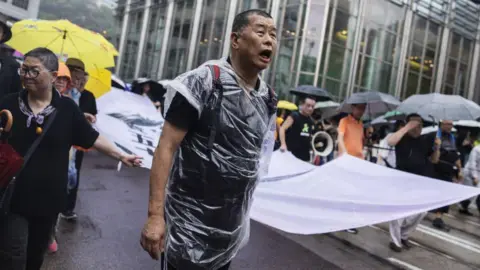
Hong Kong pro-democracy campaigner and media tycoon Jimmy Lai has been found guilty of colluding with foreign forces under the city's controversial national security law (NSL).
The 78-year-old UK citizen, who has been in jail since December 2020, pleaded not guilty. He faces life in prison and is expected to be sentenced early next year.
Lai used his now-defunct Apple Daily newspaper as part of a wider effort to lobby foreign governments to impose sanctions on Hong Kong and China, the court found.
Hong Kong's chief executive John Lee welcomed the verdict, noting that Lai's actions damaged the country's interests and the welfare of Hong Kongers. Rights groups called it a cruel judicial farce.
They say the NSL, which Beijing defends as essential for the city's stability, has been used to crush dissent.
Delivering the verdict on Monday, Judge Esther Toh said there is no doubt that Jimmy Lai harboured hatred for the People's Republic of China (PRC), citing his constant invitation to the US to help bring down the government of the PRC with the excuse of helping the people of Hong Kong.
Despite denying all charges against him, claiming he had never used foreign contacts to influence policies for Hong Kong, the trial represents ongoing crackdowns on pro-democracy activists since the imposition of the NSL in 2020.
As the indictment continues to reveal the circumstances under which Lai was tried, critics underline the implications for judicial independence in Hong Kong, where nearly every individual charged under the NSL has been convicted.
Echoing this sentiment, human rights organizations implore the international community to intervene, stressing that trials like Lai's reflect the broader governmental efforts to eliminate dissent within Hong Kong.
Lai's son has urged the UK government to increase pressure for his father's release, emphasizing the need for concerted action in the face of the growing authoritarian governing tactics employed by Beijing.
With global implications for free expression and civil rights, Lai's story is emblematic of the struggle to uphold fundamental rights in an increasingly oppressive environment.