In brief
In the aftermath of Syria's civil war, forensic teams are racing against time to identify victims from mixed mass graves, while the anguish of mothers and families continues as they search for their missing loved ones amidst bureaucratic hurdles.
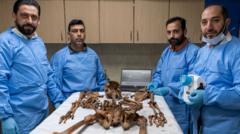
Dr. Anas al-Hourani stands in the newly inaugurated Syrian Identification Centre, overseeing the forensic team’s painstaking work to identify human remains from a mixed mass grave. Marked by the brutal legacy of a civil war that claimed hundreds of thousands of lives, these bones belong to individuals whose stories are etched in the tragedy of the Assad regime's violence. Al-Hourani, a forensic odontologist, explains that the femurs displayed on tables can reveal crucial details like height, age, and possible occupation, yet the gold standard of DNA testing remains out of reach due to logistical constraints, international sanctions, and high costs. Despite the new government's stated priority of "transitional justice," many Syrians feel their pain is overlooked, with families yearning for personified justice and recognition of their grief. Estimates suggest over 130,000 individuals have forcibly disappeared throughout the conflict, complicating the process of recovering and identifying remains. Even if a victim can be pinpointed from a mass grave, the identification procedure could take up to months, adding to the emotional toll on families left in limbo.A visit to one of the burial sites near Damascus reveals stark evidence of the atrocities committed. Hussein Alawi al-Manfi, known as Abu Ali, recounts his harrowing experience of transporting lorry-loads of corpses—often civilians—to burial pits, detailing the dehumanizing routine that became tragically normalized over years of conflict. Accompanied by community witnesses, his testimony underlines the relentless reality of horror experienced during the war.Among the survivors is Malak Aoude, who recently returned to Syria after years as a refugee, still in search of her two sons who disappeared during their enlistment in the Assad regime’s army. As she navigates the remnants of her children’s lives, the frustration of insufficient answers persists. The discovery of records linking her missing son to the infamous detention center, Branch 215, deepens her anguish. Hope momentarily flickered with the fall of Assad, yet the ongoing uncertainty blinds her to closure.As the Syrian Identification Centre works at a painstaking pace, families like Aoude's remain ensnared in a web of grief, waiting for recognition and justice in a country still haunted by its brutal past. Nearly a decade after the onset of the civil war, the path to healing is fraught with obstacles, highlighting the significant need for support, acknowledgment, and a commitment to accountability for those lost.