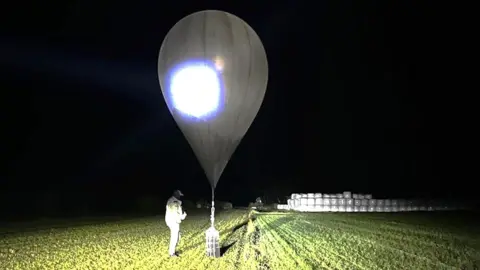
Whenever the wind blows northwest from Belarus, Lithuania braces for problems. That's when giant white balloons are launched across the border, crates of cheap cigarettes dangling beneath. Over the past 10 weeks, the illicit balloon traffic has already forced Lithuania's main airport into shutdown 15 times, stranding or delaying thousands of travellers. On one occasion, the airspace was closed completely for 11 hours.
But the government here is sure it is dealing with something far more hostile than smugglers. It says the balloons have been weaponised in an act of hybrid warfare by Belarus, Russia's closest ally. It is happening just as Moscow's own shadow war on Europe is escalating again with a wave of arson and sabotage attacks that officials link to Russian intelligence.
The Lithuanian government has declared an emergency situation. Balloons have been used by smugglers before, but this October their number suddenly surged. Of course it started as organised crime activity across the border, but we've seen more than once how Belarus instrumentalises organised crime to have an effect on neighbouring countries, Foreign Minister Kestutis Budrys told the BBC in the capital Vilnius. He says the balloons are launched from spots that help them best target Lithuania's main airport, just 30km (19 miles) from the border.
The government believes the balloons signify a form of political blackmail on Europe's eastern edge. While previous smuggling operations often used more discreet methods, these balloon launches are seen as a direct act of provocation. With the threat growing, military police have increased patrols in the border zone, particularly at night.
To combat this, Lithuania is using military radar to track the balloons, has offered a €1 million reward for technology to intercept them, and has implemented tighter security measures. However, the best safeguard remains a change in wind direction, which could halt the balloons from crossing into Lithuanian airspace.
Despite claims from Belarus' leader Alexander Lukashenko dismissing these events as mere smuggling, Lithuanian officials argue that the state’s support for such actions reflects a deliberate attempt to leverage the situation politically, potentially influencing European policy and sanctions against Belarus.
As the situation continues, airports and airlines are adapting to this unexpected challenge, with some flights being rerouted or canceled. Citizens express their worries, aware that this could be a test of NATO's preparedness against unconventional threats, signaling a critical moment in Lithuania's ongoing struggle with its eastern neighbor.
But the government here is sure it is dealing with something far more hostile than smugglers. It says the balloons have been weaponised in an act of hybrid warfare by Belarus, Russia's closest ally. It is happening just as Moscow's own shadow war on Europe is escalating again with a wave of arson and sabotage attacks that officials link to Russian intelligence.
The Lithuanian government has declared an emergency situation. Balloons have been used by smugglers before, but this October their number suddenly surged. Of course it started as organised crime activity across the border, but we've seen more than once how Belarus instrumentalises organised crime to have an effect on neighbouring countries, Foreign Minister Kestutis Budrys told the BBC in the capital Vilnius. He says the balloons are launched from spots that help them best target Lithuania's main airport, just 30km (19 miles) from the border.
The government believes the balloons signify a form of political blackmail on Europe's eastern edge. While previous smuggling operations often used more discreet methods, these balloon launches are seen as a direct act of provocation. With the threat growing, military police have increased patrols in the border zone, particularly at night.
To combat this, Lithuania is using military radar to track the balloons, has offered a €1 million reward for technology to intercept them, and has implemented tighter security measures. However, the best safeguard remains a change in wind direction, which could halt the balloons from crossing into Lithuanian airspace.
Despite claims from Belarus' leader Alexander Lukashenko dismissing these events as mere smuggling, Lithuanian officials argue that the state’s support for such actions reflects a deliberate attempt to leverage the situation politically, potentially influencing European policy and sanctions against Belarus.
As the situation continues, airports and airlines are adapting to this unexpected challenge, with some flights being rerouted or canceled. Citizens express their worries, aware that this could be a test of NATO's preparedness against unconventional threats, signaling a critical moment in Lithuania's ongoing struggle with its eastern neighbor.