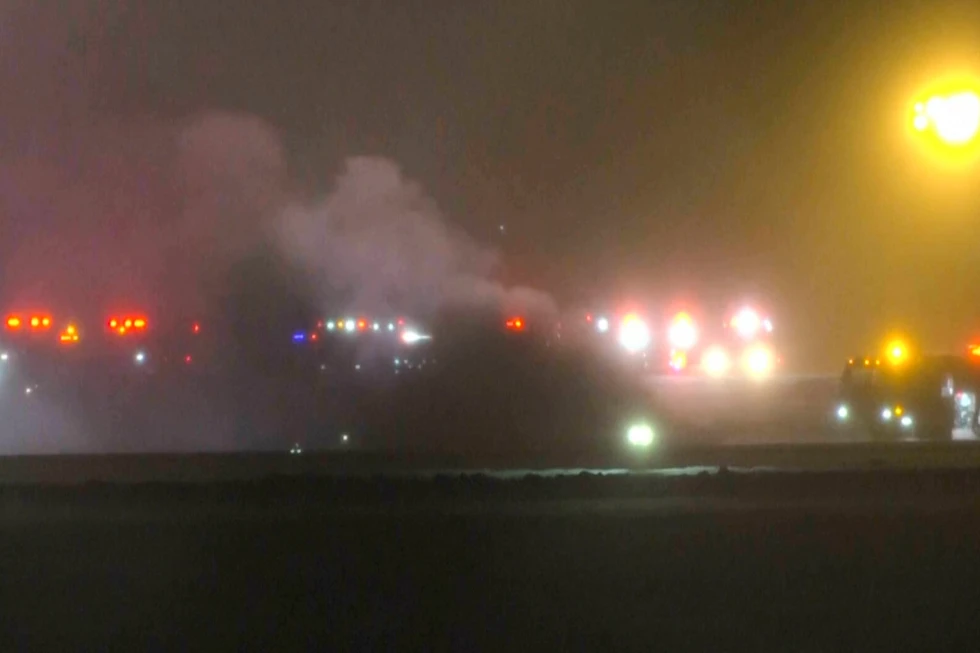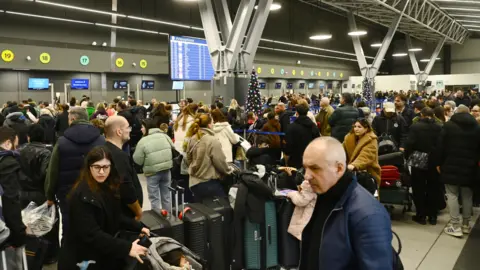
Thousands of passengers are stranded across Europe after a communications failure forced Greece to close its airspace, causing widespread cancellations and delays.
Officials are working to understand why radio communications were disrupted on Sunday morning, prompting the temporary suspension of arrivals and departures.
Some departures have since been allowed to resume - though inbound flights are still being told to divert or return to their point of origin. Athens' main airport is among the worst affected, while Thessaloniki airport has closed entirely.
The timing of the disruption has raised fears that travellers will not be able to get home before the start of the working week.
I was supposed to fly to London, via Stockholm, with SAS, one passenger at Athens International Airport told Greek broadcaster Mega TV. I'm working on Newport Hospital tomorrow morning. I'm not going to be there on time, I don't know what else to say.
Who is going to pay for the additional cost this travel will cost me? We still don't know if and when we're going to leave, no one is telling us anything.
More than 90 flights have been affected in and out of Athens airport alone - though some flights have since been able to resume.
A member of staff in the airport told the BBC that 35 aircraft an hour were now being allowed to take off, but it was still unable to take inbound flights.
Flights departing from Dublin, Barcelona, and Paris were earlier ordered to return to their airports of origin, while services from Copenhagen and Malta were cancelled altogether.
Other arrivals into Athens were placed on standby, while flights in and out of other Greek airports have also been affected. Three flights out of Heraklion airport on the island of Crete, including one to Munich, have been delayed, according to public broadcaster ERT.
Most inbound flights are being diverted to Turkey if not cancelled outright, it reports.
The disruption comes at a busy time for air travel in and out of Athens, which typically sees more than 600 scheduled flights per day, as people return from winter holidays.
In the chaos, some passengers have complained of a lack of information.
One told news site Flash: We have no updates. They told us that we will be able to leave but I don't think this is true. On the departures board I can't see my flight, and I'm supposed to leave shortly.
Another, who had been on a flight to Rhodes when it turned around and headed back to Athens, told news agency Reuters: From that moment until now we have no information whatsoever.
Domestic travellers may have the option of getting home on Greece's rail network, but this would take significantly longer.
The issue that caused the disruption is thought to concern the radio system used by air traffic controllers to communicate with planes in their airspace.
Panagiotis Psarros, chair of the Association of Greek Air Traffic Controllers, told ERT that all frequencies were suddenly lost, adding: We could not communicate with aircraft in the sky.
The broadcaster later reported an initial investigation by the Greek security services that suggested the problem may be due to the failure of an antenna in the Gerania Mountains near Athens.
Italy, Turkey, and Cyprus are assisting Greece in managing the situation.