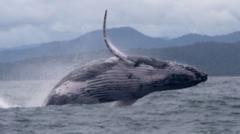
In a startling revelation, a humpback whale has emerged as a champion of endurance, embarking on one of the longest migrations ever recorded, with experts suggesting that climate change may have spurred this extraordinary journey. Initially spotted in the Pacific Ocean off the coast of Colombia in 2017, the whale reappeared several years later near Zanzibar in the Indian Ocean, covering a staggering distance of at least 13,000 km.
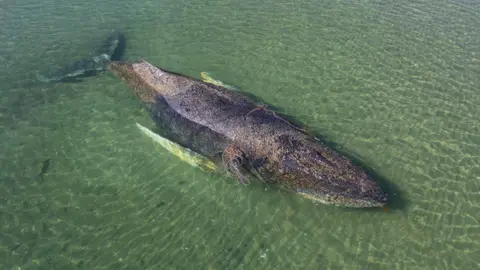
The remarkable journey has left ecologists and marine biologists, including Ekaterina Kalashnikova of the Tanzania Cetaceans Program, in awe. Kalashnikova remarked on the unprecedented nature of this migration, labeling it as "truly impressive and unusual" even for a species renowned for its migratory instincts. A photograph from 2022 depicts the very same whale off the coast of Zanzibar, documenting its incredible voyage.
Experts believe that this specific male whale's odyssey, which may represent the furthest any humpback has traveled, could be attributed to changing ocean conditions influenced by climate change. One prevailing hypothesis posits that diminishing krill populations—tiny shrimp-like creatures that are a primary food source for humpbacks—have forced these majestic mammals to expand their range in search of sustenance. Alternatively, some researchers speculate that recovering whale populations, bolstered by global conservation efforts, may be prompting exploration of new breeding sites.
Dr. Kalashnikova emphasizes that while the precise reasons for such migrations remain elusive, the interplay of climate change, environmental disturbances, and biological factors of the species could be key drivers. According to BBC’s Victoria Gill, humpbacks are known for their annual migrations from colder feeding grounds near the poles to warmer breeding waters closer to the equator; nonetheless, this particular male's journey encompasses two vastly distant breeding sites.
The whale was part of a series of sightings documented by researchers as early as 2013 on the Colombian coast, with notable reappearances in 2017 and 2022. The brace of observations is calculated based on a great-circle distance, which quantifies the shortest route between two points on a sphere. The data utilized for this research stem from a collaborative citizen science initiative, happywhale.com, where images of whale tails were submitted and systematically matched using artificial intelligence technologies, meticulously tracking global whale movement.
This astonishing tale of migration beckons attention to the consequences of climate variations on our oceans and their inhabitants, intensifying the urgency to protect these majestic creatures and their ecosystems. For further exploration on humpback whales, viewers can access BBC iPlayer's "The Secrets of Antarctica's Giants."
The remarkable journey has left ecologists and marine biologists, including Ekaterina Kalashnikova of the Tanzania Cetaceans Program, in awe. Kalashnikova remarked on the unprecedented nature of this migration, labeling it as "truly impressive and unusual" even for a species renowned for its migratory instincts. A photograph from 2022 depicts the very same whale off the coast of Zanzibar, documenting its incredible voyage.
Experts believe that this specific male whale's odyssey, which may represent the furthest any humpback has traveled, could be attributed to changing ocean conditions influenced by climate change. One prevailing hypothesis posits that diminishing krill populations—tiny shrimp-like creatures that are a primary food source for humpbacks—have forced these majestic mammals to expand their range in search of sustenance. Alternatively, some researchers speculate that recovering whale populations, bolstered by global conservation efforts, may be prompting exploration of new breeding sites.
Dr. Kalashnikova emphasizes that while the precise reasons for such migrations remain elusive, the interplay of climate change, environmental disturbances, and biological factors of the species could be key drivers. According to BBC’s Victoria Gill, humpbacks are known for their annual migrations from colder feeding grounds near the poles to warmer breeding waters closer to the equator; nonetheless, this particular male's journey encompasses two vastly distant breeding sites.
The whale was part of a series of sightings documented by researchers as early as 2013 on the Colombian coast, with notable reappearances in 2017 and 2022. The brace of observations is calculated based on a great-circle distance, which quantifies the shortest route between two points on a sphere. The data utilized for this research stem from a collaborative citizen science initiative, happywhale.com, where images of whale tails were submitted and systematically matched using artificial intelligence technologies, meticulously tracking global whale movement.
This astonishing tale of migration beckons attention to the consequences of climate variations on our oceans and their inhabitants, intensifying the urgency to protect these majestic creatures and their ecosystems. For further exploration on humpback whales, viewers can access BBC iPlayer's "The Secrets of Antarctica's Giants."