In brief
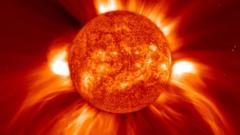
India’s groundbreaking Aditya-L1 solar mission recently documented its first significant observations, allowing scientists to analyze the risks associated with coronal mass ejections (CMEs). The data, collected by the Visible Emission Line Coronagraph (Velc), reveals vital insights into these massive solar phenomena, their potential effects on Earth’s technology, and the importance of proactive monitoring to mitigate risks.
The Indian space agency ISRO has made a significant leap in solar science with the Aditya-L1 mission. On July 16, Velc, one of the mission’s key instruments, provided data that accurately marked the onset of a coronal mass ejection, a substantial solar event that can significantly influence Earth's technological systems. Prof. R. Ramesh, Principal Investigator for Velc from the Indian Institute of Astrophysics, reported that CMEs can manifest as colossal fireballs composed of charged particles, weighing up to a trillion kilograms, and can travel towards Earth at remarkable speeds of up to 3,000 kilometers per second. These events typically arise from the Sun’s outer corona, but their trajectory can change, sometimes diverting away from Earth altogether, as seen in the recent CME captured by Velc.While many solar events do not directly threaten life, they pose serious risks to communication and power infrastructure on Earth. The potential for disruption caused by CMEs affects nearly 7,800 satellites orbiting the planet, leading to disturbances in communications systems and power grids. For instance, historical events like the 1859 Carrington Event disrupted global telegraph systems, and more recent occurrences have affected air traffic control in Europe.In contrast, early detection and monitoring through missions like Aditya-L1 could enable timely precautions to shield technological infrastructure from adverse solar influences, thus preventing chaos in modern communication networks. Notably, Aditya-L1 stands out in its ability to observe the Sun continuously from its vantage point in space, allowing it to gather data at all times without interruption. Comparatively, its structure provides a unique advantage over other solar observatories, enabling clearer visibility of CMEs as they initiate.India’s commitment to solar research, along with ground-based observatories, enhances the potential for comprehensive solar studies. As the global outlook on space weather evolves, Aditya-L1 establishes India as a crucial player in solar observation and the understanding of the Sun's interactions with Earth. Following this remarkable success, the scientific community looks forward to further findings that will undoubtedly enrich our understanding of solar dynamics and ensure the resilience of our technological society against solar threats.