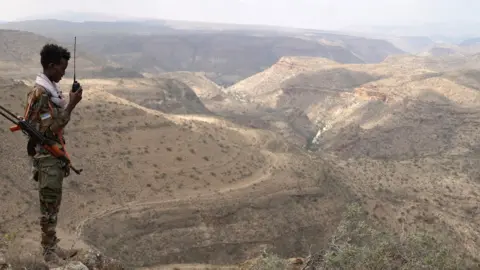
In Somalia's remote al-Miskad mountains, a group of soldiers huddles around a small hand-held screen, tracking Islamic State group fighters on a drone feed. The visibility in mountainous terrain has brought renewed scrutiny to the fight against the insurgency, ignited by IS's establishment of bases as they shift focus to Africa post their defeats in Syria and Iraq.
The Puntland Defence Forces, now bolstered to nearly 500 soldiers, are faced with the daunting task of uprooting IS fighters from their hideouts in the bastions of harsh terrain that were once the domain of nomadic communities. American forces have provided vital support through drone strikes and intelligence, estimating that IS is capable of controlling a significant part of its global operations from Somalia.
However, the threat level appears constrained as IS's capability to stage attacks has declined on a local scale, while Tricia Bacon from the Policy Anti-Terrorism Hub at American University notes that the group still serves as a critical resource network for other affiliates globally.
The local population recounts stories of brutality and fear inflicted by IS. Harsh rules on lifestyle dictated their day-to-day existence, instilling fear among the villagers. Some, such as local imam Said Mohamud Ibrahim, were displaced from their places of worship, while others have suffered personal losses, including abductions of loved ones, deepening the scars left by the group's former reign of terror.
Despite the ongoing battles and losses, soldiers like Muna Ali Dahir remain steadfast. As one of the few female officers among the ranks, she invokes a profound sense of duty towards her land and family.
While victories are celebrated, the potential for IS's resurgence looms over the forces, with members pledging to continue their campaign until every remnant of extremism is eradicated. Local perceptions of the militants have begun to change, leaning towards fearlessness against an adversary that once seemed insurmountable. With resources and support dwindling, the nature of the fight continues to shift but the stakes remain profoundly high in this strategic region of Africa.
The Puntland Defence Forces, now bolstered to nearly 500 soldiers, are faced with the daunting task of uprooting IS fighters from their hideouts in the bastions of harsh terrain that were once the domain of nomadic communities. American forces have provided vital support through drone strikes and intelligence, estimating that IS is capable of controlling a significant part of its global operations from Somalia.
However, the threat level appears constrained as IS's capability to stage attacks has declined on a local scale, while Tricia Bacon from the Policy Anti-Terrorism Hub at American University notes that the group still serves as a critical resource network for other affiliates globally.
The local population recounts stories of brutality and fear inflicted by IS. Harsh rules on lifestyle dictated their day-to-day existence, instilling fear among the villagers. Some, such as local imam Said Mohamud Ibrahim, were displaced from their places of worship, while others have suffered personal losses, including abductions of loved ones, deepening the scars left by the group's former reign of terror.
Despite the ongoing battles and losses, soldiers like Muna Ali Dahir remain steadfast. As one of the few female officers among the ranks, she invokes a profound sense of duty towards her land and family.
While victories are celebrated, the potential for IS's resurgence looms over the forces, with members pledging to continue their campaign until every remnant of extremism is eradicated. Local perceptions of the militants have begun to change, leaning towards fearlessness against an adversary that once seemed insurmountable. With resources and support dwindling, the nature of the fight continues to shift but the stakes remain profoundly high in this strategic region of Africa.