In brief
The Greek island of Santorini has experienced a wave of seismic activity, culminating in a powerful 5.3 magnitude earthquake, marking the strongest tremor yet amid ongoing geological instability.
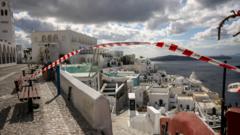
In a dramatic turn of events, a series of earthquakes has rocked Santorini and its neighboring islands, with thousands of tremors recorded over the last fortnight. The latest earthquake struck at shallow depths, registering 5.3 on the Richter scale, and was felt as far as Athens. Since late January, over 12,800 quakes have been detected by seismologists at the University of Athens, a phenomenon that has sparked a state of emergency on the island until at least early March.Residents on Amorgos Island, near Santorini, remain vigilant as the country deals with a “seismic crisis.” On Sunday alone, a tremor measuring 5.0 was preceded by multiple smaller quakes exceeding 4.0. Local authorities have been strictly monitoring the situation, especially as landslides continue across Santorini, and some locals have taken to patrolling hazardous areas to prevent curious tourists from venturing too close to dangerous cliffs.While inspections confirm that buildings on both Santorini and Amorgos have survived without significant damage and no injuries reported, the psychological impact on residents is palpable. More than 11,000 individuals have evacuated the islands since the unrest began, and schools across the affected areas will remain closed in light of safety concerns.Emergency response teams, including specialized disaster units, are actively deployed to assess the situation and repair essential services like electricity. Kostas Papazachos, a notable seismologist, conveys cautious optimism, suggesting the possibility of a gradual decline in tremors. However, he cautions against underestimating the risk of further significant seismic events.The current unrest appears to be attributed to tectonic shifts rather than volcanic activity, despite Santorini’s location on the Hellenic Volcanic Arc. Scientists acknowledge the unpredictability inherent to seismic events, complicating efforts for timely warnings or assessments.As tourism is a cornerstone of Santorini’s economy, the changing routes of cruise ships, like the Viking Star which has diverted to avoid congestion during this seismic crisis, signal broader implications for local businesses and livelihoods, even as the fate of the island and its people remains uncertain. This continuing saga of seismic occurrences serves as a stark reminder of the island's geological volatility and the resilience of its resident communities in the face of nature's unpredictability.