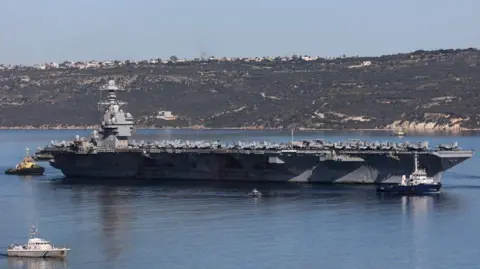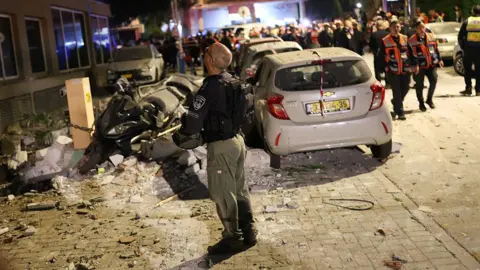
Amid the din of global speculation over US military build-up in the Middle East, Israel's leaders have remained unusually silent. Aside from some remarks in support of Iran's anti-government protests this month, Israel's prime minister has had little to say publicly about his superpower ally taking on his biggest enemy. His government has remained equally silent.
It shows you the importance Netanyahu puts on this moment, said Danny Citrinowicz, who served for 25 years in Israel's Defence Intelligence, and is now senior Iran researcher at Israel's Institute for National Security Studies.
For Netanyahu, being in this position where the US has so many forces in the Gulf, being so close to Trump attacking Iran, this is - for him - a golden moment in time that he cannot forgo.
Asaf Cohen, a former deputy director of Israel's signals intelligence unit, says there's strategy in Israel's silence too. The [Israeli] leadership believes we should allow the Americans to lead the way this time, because they are stronger, have more capabilities, and have much more legitimacy in the world.
Benjamin Netanyahu has long seen Iran as the key threat facing Israel, and the biggest source of instability in the Middle East. His public silence does not signal a lack of private discussion with his key US ally. This week, Israel's military intelligence chief, Shlomi Binder, met US intelligence agencies in Washington. According to Israeli media, the discussion focused on possible targets in Iran.
Citrinowicz believes Netanyahu is privately pushing the US towards maximalist strikes aimed at regime change in Iran, and that when Netanyahu reportedly urged Trump to hold back earlier this month, he viewed the planned US attack as too small.
The discussion is complicated by increasing calls within Israel to take aggressive action against Iran, seen as a way to eliminate threats from its ballistic missiles and nuclear ambitions. As tensions mount, Israeli voters remain divided on how to proceed.
However, significant risks lie in pursuing regime change. Many experts warn that removing the Iranian regime without a clear successor could lead to greater instability, potentially spilling over into broader regional conflict.
Netanyahu's complex balancing act between seizing an opportunity and avoiding disastrous outcomes is becoming a focal point of Israeli political strategy as elections approach. Support for military action remains high among the Israeli populace, but the underlying tensions and potential for miscalculation loom large in discussions of the future of US-Iran relations.