In brief
Two days of talks between Ukraine, Russia and the United States in Oslo and St Petersburg yielded little progress. Norwegian Prime Minister described the meetings as “good and constructive,” yet Vladimír Putin remains unwilling to negotiate directly with President Volodymyr Zelensky. The Kremlin signals a potential return to trilateral talks next month in Abu Dhabi, but only at a technical level. U.S. special envoy Steve Witkoff acknowledges more work is needed, while Russian officials express doubt over any imminent resolution. The current diplomatic climate suggests the war will continue as Ukraine's defenses face severe strain, especially with winter approaching.
After two days of diplomacy – in Norway's capital and Russia's St Petersburg – is the war in Ukraine any closer to ending?
"Good and constructive" is how Norway's prime minister described Tuesday's talks between Ukrainian President Volodymyr Zelensky, US President Donald Trump's special envoy Steve Witkoff and European representatives.
In Oslo, the idea of a trilateral meeting at leaders' level was floated. The hope was that Steve Witkoff's trip to Russia would pave the way for President Vladimir Putin, Zelensky and Trump to meet and agree an end to the fighting.
But Putin has shown little desire to share a table with Zelensky – unless that table is in Moscow.
The Kremlin says it may be willing to resume trilateral talks next month in Abu Dhabi, but only at the technical level.
In a post on X, Steve Witkoff himself conceded that "there is still important work to do", though he claimed "President Trump remains committed to seeing this war end…"
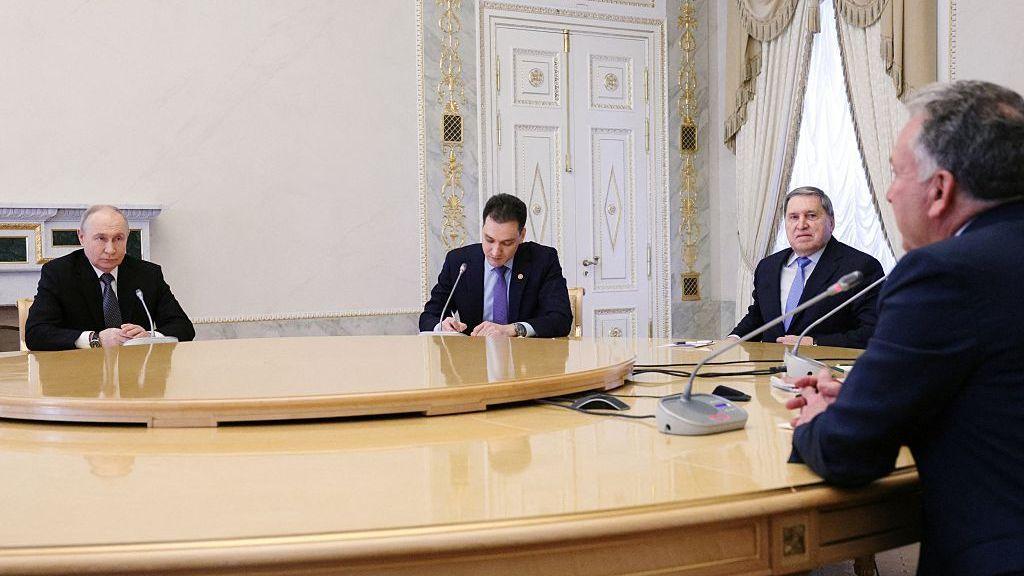
Reactions from St Petersburg
For me, the most telling statement of the day was from Vladimir Putin's foreign policy aide Yuri Ushakov. He took part in the St Petersburg talks.
Ushakov said that Steve Witkoff had told President Putin about the discussions in Oslo and (as Witkoff viewed them) "new approaches from the Europeans and Kyiv".
The Kremlin adviser was clearly unimpressed by what he heard.
"In terms of resolving the Ukraine crisis, there wasn't much there that was useful," commented Ushakov.
Later Russian state TV asked him about the prospects for peace. "I don't know how close we are getting," Yuri Ushakov said, "but things are moving in that direction."
All rather vague.
It seems that President Putin doesn't feel under pressure right now to end the war.
He knows that Ukraine's air defences are under severe strain.
He knows that winter is coming and may well view the cold weather as an opportunity to pound Ukraine into submission.
He also knows that there is a U.S. president in the White House who clearly wants a bigger, better, more profitable relationship with Moscow.
Future diplomatic possibilities
A Putin‑Zelensky‑Trump trilateral may not be imminent.
But in China next month a meeting between Vladimir Putin, Donald Trump and Xi Jinping may well take place on the fringes of the Apec summit.
Some commentators here are already dubbing it "The New Yalta" - a reference to the Yalta Conference of 1945, where Stalin, Churchill and Roosevelt met to plan the political and territorial reorganisation of post‑war Europe.
"Russia, China and the United States are the only superpowers right now in the world," Evgeny Popov says. "Of course, it will be good for the entire world if our leaders meet in China."
After nearly five years of war, that would put Vladimir Putin exactly where he wants to be - at the top table of global politics.