In brief
Recent discoveries of photographs from the civil disobedience movement in India reveal the powerful involvement of women in the struggle against colonialism. The visual records highlight their leadership, challenges faced, and the shifts in gender dynamics during this pivotal period in history. Scholars are now bringing these previously unrecognized contributions to light through exhibitions and publications.
In India, a set of recently discovered photographs is drawing attention to the role of women in one of the country's biggest anti-colonial movements, known as the civil disobedience movement, led by Mahatma Gandhi in 1930-31.
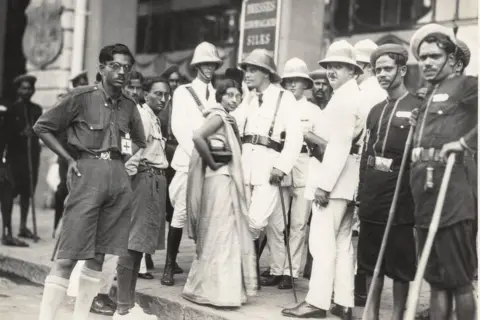
The images do not simply capture female participation; they are visual proof of how women commanded and dominated political activity, often relegating men to the sidelines.
In April 1930, Gandhi concluded his pivotal salt march, breaking the British monopoly on salt production - a charged symbol of colonial misrule. Raising a handful of muddy salt from the sea, he declared himself to be shaking the foundations of the British Empire.
Afterwards, Gandhi presided over waves of civil disobedience protests, encouraging supporters of the Indian National Congress to manufacture contraband salt, boycott foreign goods, and face down phalanxes of lathi-wielding policemen. Just a few months before, the Congress had declared purna swaraj (complete independence) as its political objective for India.
Historians have long recognized the civil disobedience movement as an important turning point in Indian politics.
First, women joined anti-colonial activities in greater numbers. When Gandhi began his salt march, he forbade women from joining, but several female leaders eventually convinced him to accord them a greater role.
This visual record of female leadership is unique. Despite its leftward leanings and Gandhi's prodding, Indian nationalist activity had remained an overwhelmingly male endeavour. Now, however, women's involvement took a quantum leap.
The Nursey album documents thousands of completely unknown female volunteers, all engaged in the struggle for independence.
Women gather on the shores of Bombay's Chowpatty Beach, ready to make contraband salt. Members of the Desh Sevika, an all-female volunteer force, wrestle with police attempting to snatch away their provisional national flag. This expression of defiance is central to understanding the crucial role women played in the liberation movement.
These photographs in the Nursey album are now back in public circulation. Ramaswamy and Bhatnagar recently released a book titled, Photographing Civil Disobedience, which includes many of the images alongside articles by a number of scholars. In October, they opened two museum exhibits, both titled Disobedient Subjects, at the CSMVS Museum in Mumbai and Duke's Center for Documentary Studies.
The women volunteers of the civil disobedience movement are getting a belated acknowledgment of their defining role in one of India's biggest mass movements.