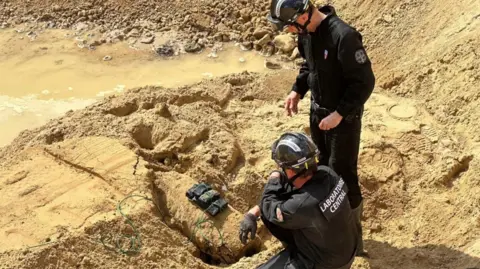
Thousands of people were evacuated from a northern suburb of Paris while a World War Two bomb was rendered safe on Sunday. Residents in Colombes living within a 450m radius of where the device was found last month were told by police to leave their homes by 07:00 local time (05:00 GMT), as authorities carried out a bomb disposal operation. An initial attempt to remove the device's detonator failed, prompting authorities to destroy the historic munition in situ with a controlled explosion.
The operation was conducted successfully, and the evacuation order was lifted by early on Sunday evening, the Préfet des Hauts-de-Seine confirmed in a statement. The bomb was discovered on 10 April during construction work on Rue des Champarons. Authorities secured the site and covered the device with sand while preparations were made for its removal.
Local official Alexandre Brugère stated that the operation would be risky and required a high level of preparation. Nearly 800 police officers were deployed to enforce a 900m-wide evacuation zone, while a second, wider zone extending a kilometre from the bomb's location limited outdoor activity. Locals received emergency alerts instructing them to leave and were informed they could not return until the operation was completed.
The authorities told us to close our windows and shutters when we left the house, but we didn't take anything - we left everything as it was, said resident Alida. Reception centres were established for those forced to leave their homes, providing assistance to vulnerable residents. Police confirmed that the controlled detonation occurred at 15:20, and the evacuation order was lifted shortly after 16:00.
Undetonated World War II bombs are frequently found across Europe, even 86 years after the war began. Those uncovered in urban areas, typically when digging foundations for new buildings, pose a greater risk to nearby populated areas. Recent years have seen several bombs discovered in London, necessitating evacuations of tourist areas and even the temporary closure of London City Airport. In a similar incident last year, a 500kg device was found and diffused near Gare du Nord in Paris during infrastructural work around railway lines.
The operation was conducted successfully, and the evacuation order was lifted by early on Sunday evening, the Préfet des Hauts-de-Seine confirmed in a statement. The bomb was discovered on 10 April during construction work on Rue des Champarons. Authorities secured the site and covered the device with sand while preparations were made for its removal.
Local official Alexandre Brugère stated that the operation would be risky and required a high level of preparation. Nearly 800 police officers were deployed to enforce a 900m-wide evacuation zone, while a second, wider zone extending a kilometre from the bomb's location limited outdoor activity. Locals received emergency alerts instructing them to leave and were informed they could not return until the operation was completed.
The authorities told us to close our windows and shutters when we left the house, but we didn't take anything - we left everything as it was, said resident Alida. Reception centres were established for those forced to leave their homes, providing assistance to vulnerable residents. Police confirmed that the controlled detonation occurred at 15:20, and the evacuation order was lifted shortly after 16:00.
Undetonated World War II bombs are frequently found across Europe, even 86 years after the war began. Those uncovered in urban areas, typically when digging foundations for new buildings, pose a greater risk to nearby populated areas. Recent years have seen several bombs discovered in London, necessitating evacuations of tourist areas and even the temporary closure of London City Airport. In a similar incident last year, a 500kg device was found and diffused near Gare du Nord in Paris during infrastructural work around railway lines.