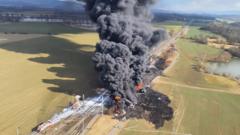
A freight train transporting hazardous benzene derailed in the Czech Republic, resulting in a significant fire that has drawn attention from both fire services and environmental experts. The incident occurred near Hustopeče nad Bečvou, located approximately 50 kilometers southwest of the Polish border. Local media reports indicate a rapid response, featuring firefighters from multiple regions and a mobile chemical laboratory to monitor air quality and potential risks.
The fire engulfed several tankers and a locomotive, producing a thick, black cloud of smoke visible from several kilometers away. Fortunately, there have been no reported injuries, but the scale of the fire prompted immediate safety measures. Eyewitnesses described flames reaching heights of up to 20 meters, alarming local residents.
In response to the fire, local officials instructed residents to remain indoors and avoid opening windows and doors to minimize exposure to smoke and potential toxins. Initial assessments of air quality indicate that pollution levels have not exceeded safety thresholds at this time, according to the Czech news outlet iDNES.
The train derailment was characterized by officials as a result of the train "splitting apart." A nearby electric substation caught fire, disrupting power supply to the town of Hustopeče. Firefighters utilized heavy foam to contain the situation and prevent the fire from spreading further, while a helicopter was deployed to assist in the firefighting efforts.
Officials disclosed that approximately 15 of the 17 benzene tanks were affected by the blaze. Each tanker was estimated to contain around 60 tonnes of benzene, a substance known for its carcinogenic properties. The widespread use of benzene in products such as plastics, resins, and pesticides raises concerns about long-term exposure to the chemical, as it can lead to serious health issues affecting blood and immune systems.
As investigations into the derailment's cause proceed, environmental and public health experts are closely monitoring the situation, underscoring the need for careful management of toxic materials in transportation settings.