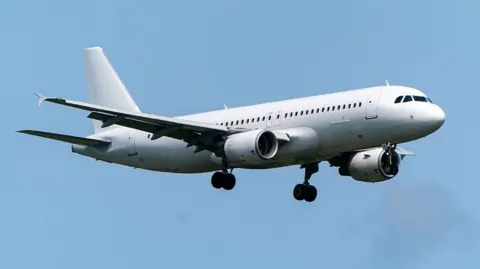
The climate-damaging vapours left behind by jet planes could be effectively reduced, according to aviation experts, with a recent study indicating that a few simple adjustments could eliminate the issue at a cost of under £4 per flight. Known as contrails, these jet condensation trails have been at the center of various conspiracy theories, but scientists are voicing concerns primarily about their contribution to global warming.
Research highlights that contrails essentially double the warming effects attributed to the aviation industry's fossil fuel usage. This pressing issue is set to be addressed in-depth at the upcoming UN climate conference, COP29, in Baku.
Contrails form under specific atmospheric conditions, akin to how breath condenses in cold air. When an airplane navigates through cold, humid air, the water vapor from the engines combines with unburned fuel particles, resulting in the visible trails. While the mechanics behind contrail formation have been understood for years, their climate impact has garnered increasing attention only recently.
Carlos Lopez de la Osa, a representative from Transport & Environment, conveys the profound effects these artificial clouds have. "They create a layer, trapping heat that would otherwise escape into space," he states, likening their warming impact to that of carbon emissions from aviation.
Despite rampant conspiracy theories associating contrails with nefarious purposes—like mind control or disease spread—experts stress that these claims lack scientific validity. Matteo Mirolo from Breakthrough Energy, who is contributing to the COP29 dialogue on this matter, outlines the need for clarity in addressing the warming implications of contrails.
The COP29 event aims to illuminate potential strategies for mitigating contrail-induced warming. Notably, a study suggests that merely 3% of flights are responsible for nearly 80% of contrail warming. By modifying the flight paths of a select few planes, it might be possible to achieve over a 50% reduction in contrail warming by 2040.
Geography significantly impacts contrail warming, with flights over North America, Europe, and the North Atlantic contributing the majority of the problem, particularly during certain times of the day and seasons. Evening and winter flights, for instance, exhibit the most significant warming effects.
According to Mr. Lopez de la Osa, additional adjustments could be integrated into current flight planning to avoid areas prone to contrail formation. “Of all the climate solutions proposed for COP29, this is arguably one of the simplest,” he affirms.
The researchers hope that by raising awareness at COP29, they can emphasize the importance of tackling contrails, highlighting its potential for a considerable climate impact at minimal cost compared to the extensive investments in sustainable aviation fuel.