In brief
Scientists and local sailors are anxiously monitoring the trajectory of iceberg A23a, which is rapidly approaching South Georgia, a crucial habitat for wildlife. As the iceberg threatens to ground and break apart, concerns rise over the impact on local ecosystems and fisheries in a changing climate.
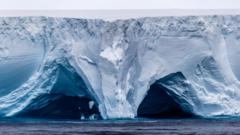
The A23a iceberg, one of the largest to date, is drifting northward from Antarctica towards South Georgia, creating a serious risk to the local penguin and seal populations. Measuring around 3,500 square kilometers, the iceberg, which originally broke away from the Filchner Ice Shelf in 1986, is currently situated approximately 173 miles from the rugged British territory. In the past, giant icebergs have severely impacted wildlife in South Georgia, leading to the death of countless seals and penguins, as vast ice masses interfered with their feeding grounds. “Icebergs are inherently dangerous. I would be extraordinarily happy if it just completely missed us,” remarked sea captain Simon Wallace while aboard the government vessel Pharos.As the iceberg approaches, a global network of scientists and fishermen closely monitors its daily movements through satellite imagery. A23a, once measuring over 3,900 square kilometers, has experienced significant decay due to warmer Northeastern Antarctic waters that have begun to melt its cliffs, which stand taller than London’s Shard. It now appears to be slowly disintegrating, with large chunks calving off and floating around South Georgia.This isn’t the first time an iceberg has threatened the region; the 2004 A38 iceberg caused a catastrophic situation for local wildlife. South Georgia, often referred to as "iceberg alley," must prepare for ongoing environmental shifts, as experts affirm that both fisheries and wildlife are capable of adapting over time.With increasing iceberg activity in local waters, fishermen like Andrew Newman from Argos Froyanes have noted the emerging challenges. “It is in bits from the size of several Wembley stadiums down to pieces the size of your desk,” he explained. Constant vigilance has become the norm for those working in these icy waters, with night searchlights necessary to navigate the perilous conditions.Although the birth of iceberg A23a predates the significant implications of contemporary climate change, scientists agree that the future holds a potential for increased ice calvings as Antarctica continues to destabilize.A significant opportunity arose when scientists from the British Antarctic Survey approached the iceberg aboard the research vessel Sir David Attenborough. There, within a crack in A23a’s towering walls, PhD researcher Laura Taylor collected valuable water samples to study how such mega icebergs inherently change the Southern Ocean's carbon cycle.“This water isn’t just like what we drink. It’s rife with nutrients and tiny life forms,” Taylor noted, emphasizing the potential of these icebergs to store carbon as they melt and release stored particles. As this natural phenomenon plays out, A23a presents both a threat and an opportunity for further understanding of the climate’s effect on marine ecosystems. Icebergs’ unpredictable nature means it remains uncertain when or how A23a will impact the region, but as it continues its journey, scientists and local communities brace for what lies ahead.